
01
At a glance
Sub-project code
SP-01 (K12-EDU), one of seven sub-projects on the Southern University Mobile CAVE
Truck domain
K-12 education and mobile STEAM outreach
Aligned program
Southern University Reaching Across the Digital Divide (SURADD)
Federal support for SURADD
a $6.2 million U.S. Department of Commerce award through the Connecting Minority Communities program
Classroom VR pilot (October 2026)
2 pilot schools, 40 headsets, 6 STEM lessons on the Meta headsets, 120 educators trained
Educators trained
80 middle school science teachers and 40 teacher candidates from the university's School of Education
Grand opening of the Mobile CAVE
Southern University, Baton Rouge, date to be announced
02
What it is
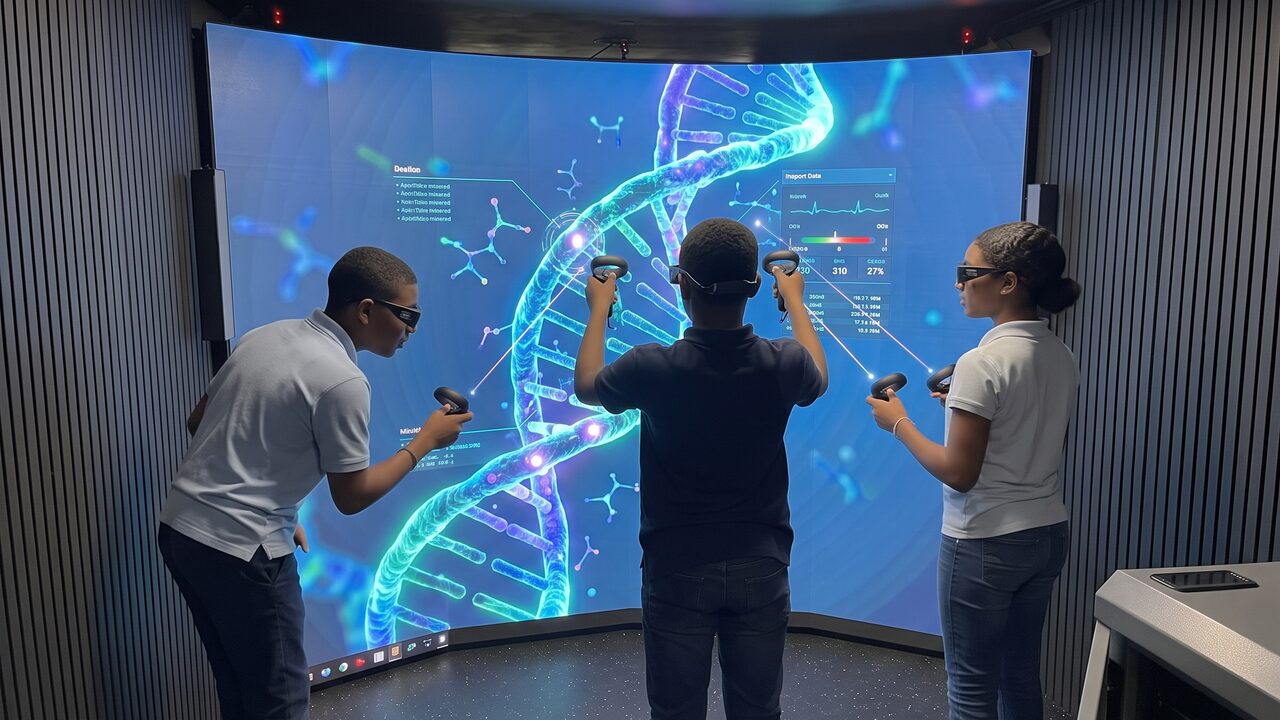
SP-01 is the part of the Southern University Mobile CAVE that serves elementary, middle and high school students. The Mobile CAVE is a 3D room built into a truck. When it parks at a school, a class steps inside, puts on 3D glasses, and stands in the middle of a science lesson that fills the walls around them. A cell becomes the size of a room. A river delta lies at their feet. A chemical reaction happens close enough to point at.
The sub-project is tied to an existing Southern University program: Southern University Reaching Across the Digital Divide, known as SURADD. SURADD already puts VR headsets and STEM lessons into K-12 classrooms and trains teachers to use them. SP-01 adds the truck. The headsets give each student a personal lesson at their desk. The truck gives a whole class a shared 3D room they can stand in together and talk through.
The idea behind both is simple. Many students learn best by seeing and doing, not only by reading. A student who struggles with a dense paragraph about the water cycle can follow it when they can watch water rise, cool and fall around them, then run the scene again and change one thing. SP-01 brings that kind of lesson to schools that have no lab, too little equipment, or no budget to bus a class to a university campus.
SP-01 is also a teacher program, not only a student program. The value of a 3D lesson depends on the teacher who frames it and the questions asked afterward. That is why SURADD trains working science teachers and future teachers alongside the hardware, and why the truck visit is built around a unit the teacher chooses.
03
How it works
A school or district starts with a short conversation. Teachers name the science unit they most want to bring to life and the part students find hardest. The visit is built around that unit, so it fits the course the class is already taking rather than replacing it.
The Mobile CAVE drives to the school and parks on site. No building has to be equipped and no class has to travel. Before stepping onto the projected floor, every student keeps their shoes on and puts shoe covers over them, then puts on 3D glasses.
Inside, the images surround the group on the walls and floor. Students move, point and change the scene, and the room responds right away. The lesson becomes something they act on, not something they copy from a diagram.
A guide replays the key moment and asks why it happened. Students run the scene again, slower, faster or with one thing changed. A live demonstration in a classroom happens once. A simulation can be repeated as often as the class needs.
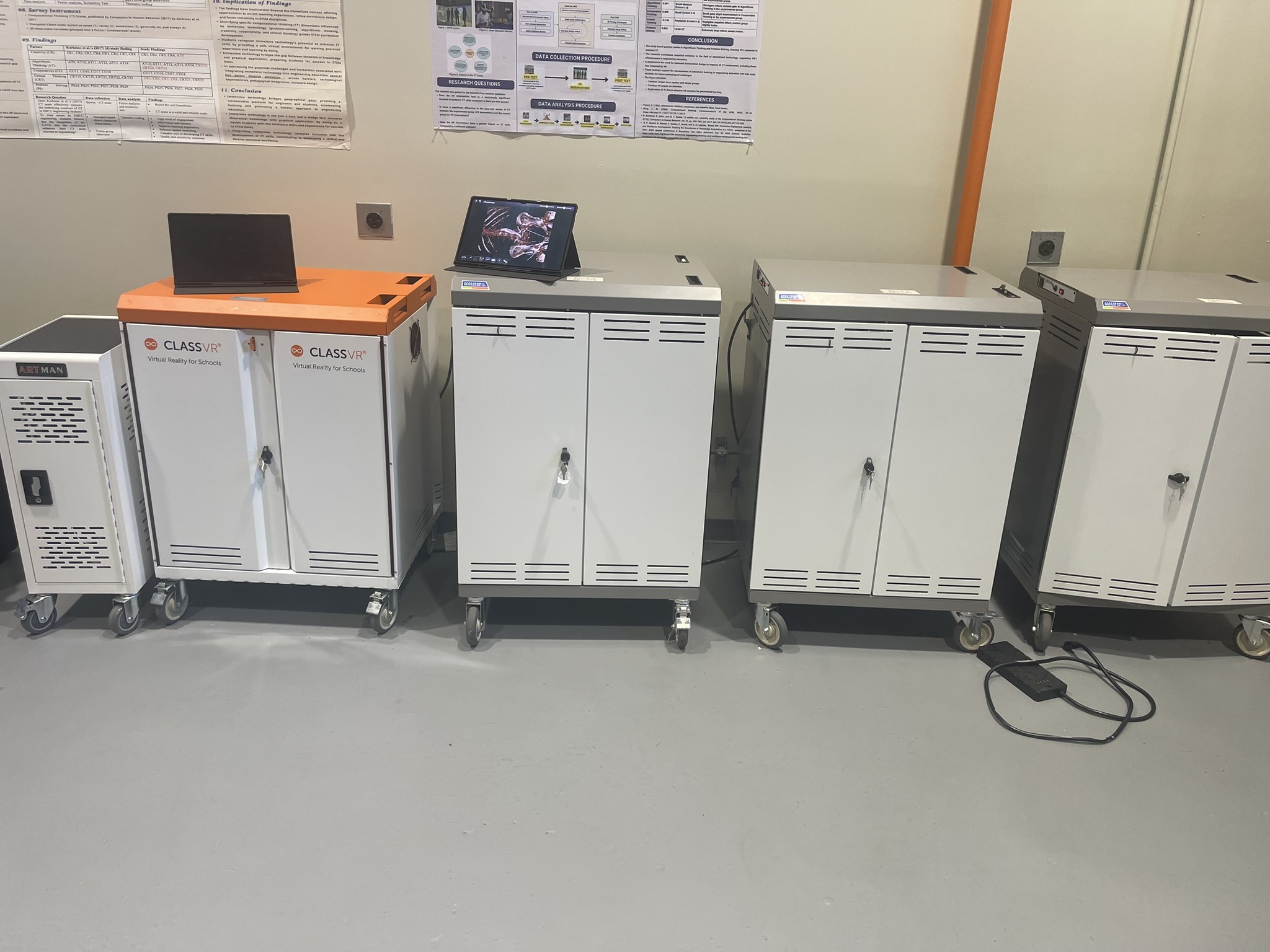
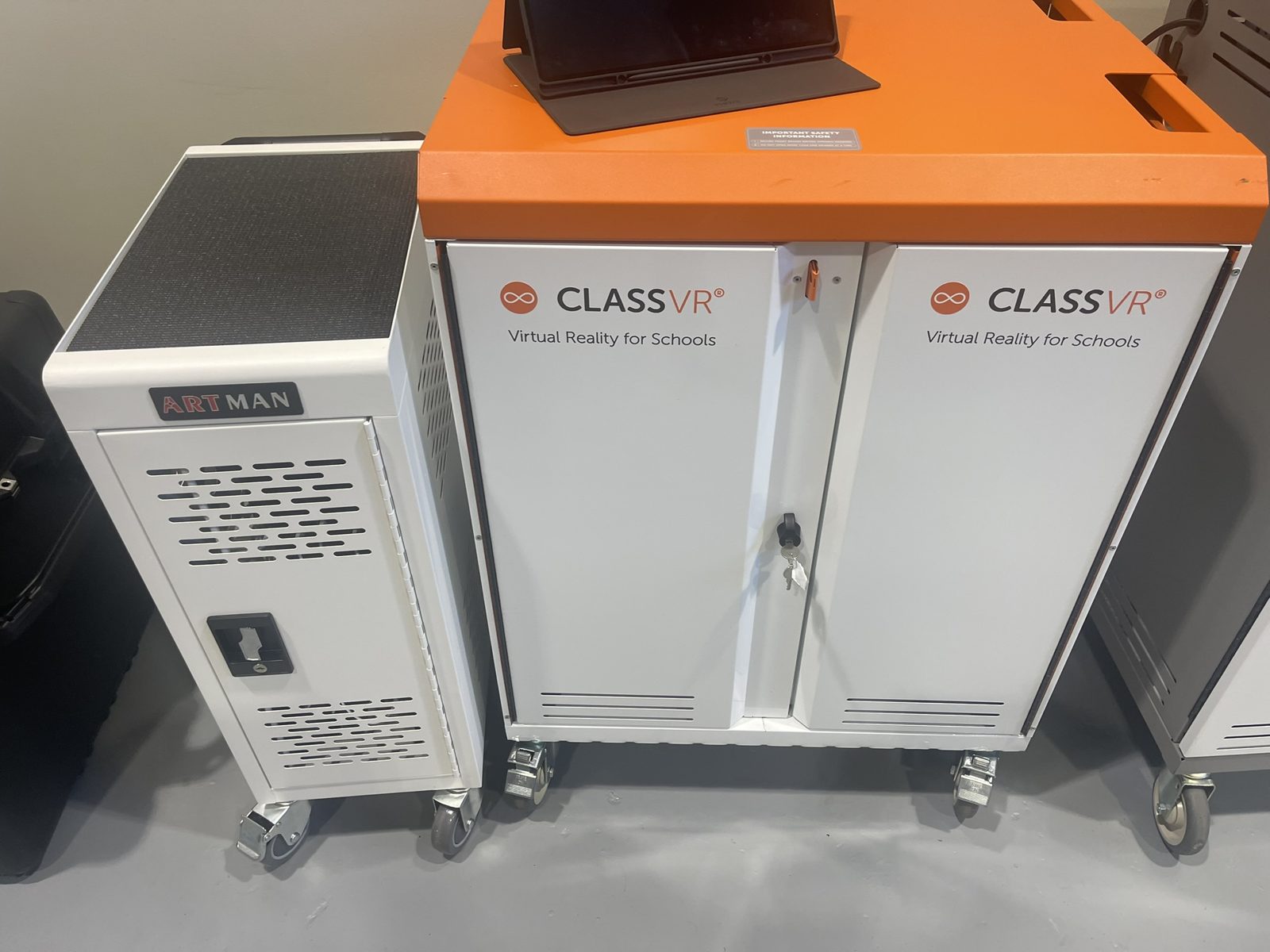
Through SURADD, pilot schools keep VR headsets for trained teachers to use in regular lessons. Meta headsets carry six middle school STEM and science lessons adapted from an existing curriculum. ClassVR headsets give access to a library of downloadable K-12 lessons in math, science and other subjects, and they charge and travel in ClassVR carts.
Teachers sign up, learn the headset hardware and classroom routines, match each VR lesson to an existing science unit, and then add VR to their normal schedule. The goal is VR as part of the normal lesson, especially for students who need another way in.
04
Impact
Closing an access gap, not just a technology gap
Louisiana students have made real gains. On the 2024 Nation's Report Card, Louisiana's fourth graders ranked in the top five states for math growth, and the state rose from 49th to 43rd in eighth-grade math between 2019 and 2024. The same results show how much work remains: eighth-grade math still ranks 43rd. State Superintendent Cade Brumley said the state is "not completely satisfied as there is more work to accomplish." Hands-on science and math experiences are one of the levers that help students who are not reached by text and lecture alone.
Reaching students where internet and labs are thin
More than a third of Louisiana's population, about 1.7 million people, lacked broadband access in late 2023, and an estimated 475,000 households had never had high-speed, affordable, reliable internet. Students in those communities cannot count on online simulations at home. A truck that brings the full experience to the school, with no download and no home connection required, reaches them directly.
An HBCU preparing the next generation of teachers
Southern University was the first institution in Louisiana that aspiring Black teachers could attend, as U.S. Commerce Secretary Gina Raimondo noted when Southern received its SURADD award. SP-01 continues that role. Teacher candidates from the School of Education train with VR before they lead their own classrooms, so the technology enters schools through teachers who already know how to use it well.
Career exposure close to home
A student who stands inside a 3D model built by Southern University students sees a path into engineering, computing, health or teaching that starts at an HBCU in their own state. The Mobile CAVE was conceived and led by students from concept to completion, and that story is part of the lesson for every young visitor.
Immersive VR helps students learn. A 2022 meta-analysis of 48 experimental studies in Educational Research Review found that immersive VR had a positive effect on learning outcomes, with a larger effect in K-12 (g = 0.61) than in higher education (g = 0.31). Compared with traditional teaching methods, the effect was g = 0.54. The same analysis found that CAVE systems had a positive effect on learning. SP-01 pairs both formats: headsets for individual practice, and a CAVE room for shared learning.
A CAVE is different from a headset in one important way for schools: a group sees the same scene at the same time and can talk to each other while they look at it. Students point, compare, argue and agree in the same space. Research on immersive collaboration has found that people working together in a CAVE-style room rated their discussion as less impersonal than pairs working in headsets. For a class, that shared view keeps the teacher in the conversation.
The technology also gives schools something they rarely get: repeatability. A lesson can be slowed, paused, replayed and changed. Students can try something that would be dangerous, expensive or impossible in a school lab, see what happens, and try again.
Over time, SP-01 builds a library. Each visit is built around a unit a teacher chose, so the set of scenes grows from real classroom needs. Lessons built in Southern University's XR Development Studio use the same tools as the AM Lab's VR modules, Unity and OpenXR, so content can move between headsets and the Mobile CAVE.
05
Why Southern University
Southern University already runs the program SP-01 depends on. SURADD received $6.2 million from the U.S. Department of Commerce's Connecting Minority Communities program to buy VR equipment, expand broadband access, and expand virtual immersion teacher training at the university's Lab School, where aspiring educators get hands-on experience with VR headsets. The project's stated aim is to decrease the digital divide by forming a K-12 workforce pipeline that engages middle school teacher candidates, clinical educators, and university faculty and students.
The university also has the people and the rooms. Its immersive technology center brings together a fleet of VR headsets, a VR development studio, fixed CAVE rooms, faculty training and K-12 outreach, including summer activities with VR, AI, drones and manufacturing. Its XR Development Studio builds and tests VR lessons and brings headsets to schools and outreach events, and the XR JAGS student team works alongside it. The stationary CAVE on campus lets teachers and students try the full room experience before the truck reaches their school.
As a land-grant HBCU founded in 1880 and part of the only HBCU system in the United States, Southern has a mission that reaches beyond its campus. SP-01 turns that mission into something a sixth grader in a rural parish can stand inside.
06
Who it serves
Middle school science students
The SURADD lessons target middle school STEM and science, the years when many students decide whether science is "for them." A shared 3D experience can change that decision.
Elementary and high school classes
The truck brings science-lesson visits to any grade. Teachers pick the unit, so the scene fits the level of the class.
Working science teachers
Eighty middle school science teachers have been trained through the classroom VR program. They learn the hardware, the routines and how each VR lesson fits a unit they already teach.
Teacher candidates
Forty future teachers from Southern University's School of Education train with VR before they lead their own classrooms, so new teachers arrive ready to use the tools.
Rural and under-resourced schools
Schools without a lab, without enough equipment, or far from campus get the same experience as schools near the university, because the room travels to them.
Families and communities
STEM nights and community visits put parents and younger siblings inside the same lesson, so learning continues at home.
07
Why fund it now
The groundwork is already paid for and running. SURADD's federal award bought equipment and launched the teacher training. Two pilot schools have 40 headsets, six STEM lessons are in use, and 120 educators are trained. Funding SP-01 now builds on a working program instead of starting one.
The Mobile CAVE is getting ready to open. Funding at launch decides how many schools the truck reaches in its first year, how many lessons are built, and how many teachers are trained to lead them. A school visit costs the school nothing in construction, so each funded day of the truck reaches a whole class at once.
Funding also keeps the free mission strong. Southern's plan for its immersive technology center keeps free demonstrations and eligible K-12 outreach while adding sponsored outreach days and contracted school and district programs. A sponsor that funds SP-01 pays for visits that schools could not otherwise afford.
Funding grows the evidence. Every visit is built around a named unit and followed by a debrief, so it can be measured. Southern's reporting rules record time spent practicing in a simulation separately from skills an instructor has checked, and only totals are shown publicly. Funders see what was practiced and what was proven.
Finally, the investment is durable. Lessons built once can be reused across headsets, the stationary CAVE and the truck, year after year, and every teacher trained keeps teaching with the tools long after the truck leaves.
08
How it connects
SP-01 is the school-facing side of Southern University's immersive work. It shares its program with Classroom VR and teacher training, which supplies the headsets, the six STEM lessons and the teacher training. It draws on the XR Development Studio, where VR lessons are built and tested, and on the Stationary CAVE, where teachers and students can try the full room on campus. The Computational thinking research project studies how VR changes the way students solve problems, which informs how SP-01 lessons are designed. On the truck, SP-01 shares the vehicle with Exploratory research and advanced visualization (SP-04) and Manufacturing technologies and cyber-additive XR (SP-05), and it depends on Student-led Mobile CAVE systems integration (SP-07) to keep the truck running on tour. The Vision module explains how all of these fit together.
09
Questions funders ask
No. Every visit is built around a unit the teacher already teaches, and the teacher leads the debrief. The 3D lesson gives students a new way into the same idea.
Headsets give each student a personal lesson. The Mobile CAVE gives a whole class one shared room where they see the same thing and talk about it together. SURADD already provides headsets; SP-01 adds the shared room.
Every visit offers an accessible option for anyone who cannot use 3D glasses, along with instructor support.
Yes. A 2022 meta-analysis of 48 experiments found immersive VR improves learning outcomes, with the strongest effect in K-12. It also found a positive effect for CAVE systems specifically.
A place to park and a class ready to learn. The truck carries the room. Visitors keep shoes on and wear shoe covers on the projected floor.
Each visit is tied to a named unit and debrief. Practice time in the simulation is recorded separately from skills an instructor has checked, and only totals are reported publicly.
Southern University was the first institution in Louisiana that aspiring Black teachers could attend, and it runs a federally funded program built to close the digital divide through a K-12 workforce pipeline. SP-01 extends that work statewide.
10
Sources
- Southern University Reaching Across the Digital Divide (SURADD): Connecting Minority Communities Pilot, NTIA
- Southern University to Boost VR Teacher Training, Broadband Access, GovTech / The Advocate, January 3, 2023
- Connecting Minority Communities Pilot Program, Internet for All
- La. fourth-graders in the top five in nation for math growth, American Press, January 31, 2025
- More than 1 in 3 Louisiana residents don't have high-speed internet, PBS NewsHour, November 16, 2023
- Coban, Bolat & Goksu (2022), The potential of immersive virtual reality to enhance learning: A meta-analysis, Educational Research Review 36
- Cordeil et al., Immersive Collaborative Analysis of Network Connectivity: CAVE-style or Head-Mounted Display?, IEEE TVCG
- Southern University and Agricultural & Mechanical College, 64 Parishes
- Classroom VR and teacher training, AM Lab
- Sub-projects, Immersion in Motion
- For schools and colleges, Immersion in Motion