01
At a glance
What it is
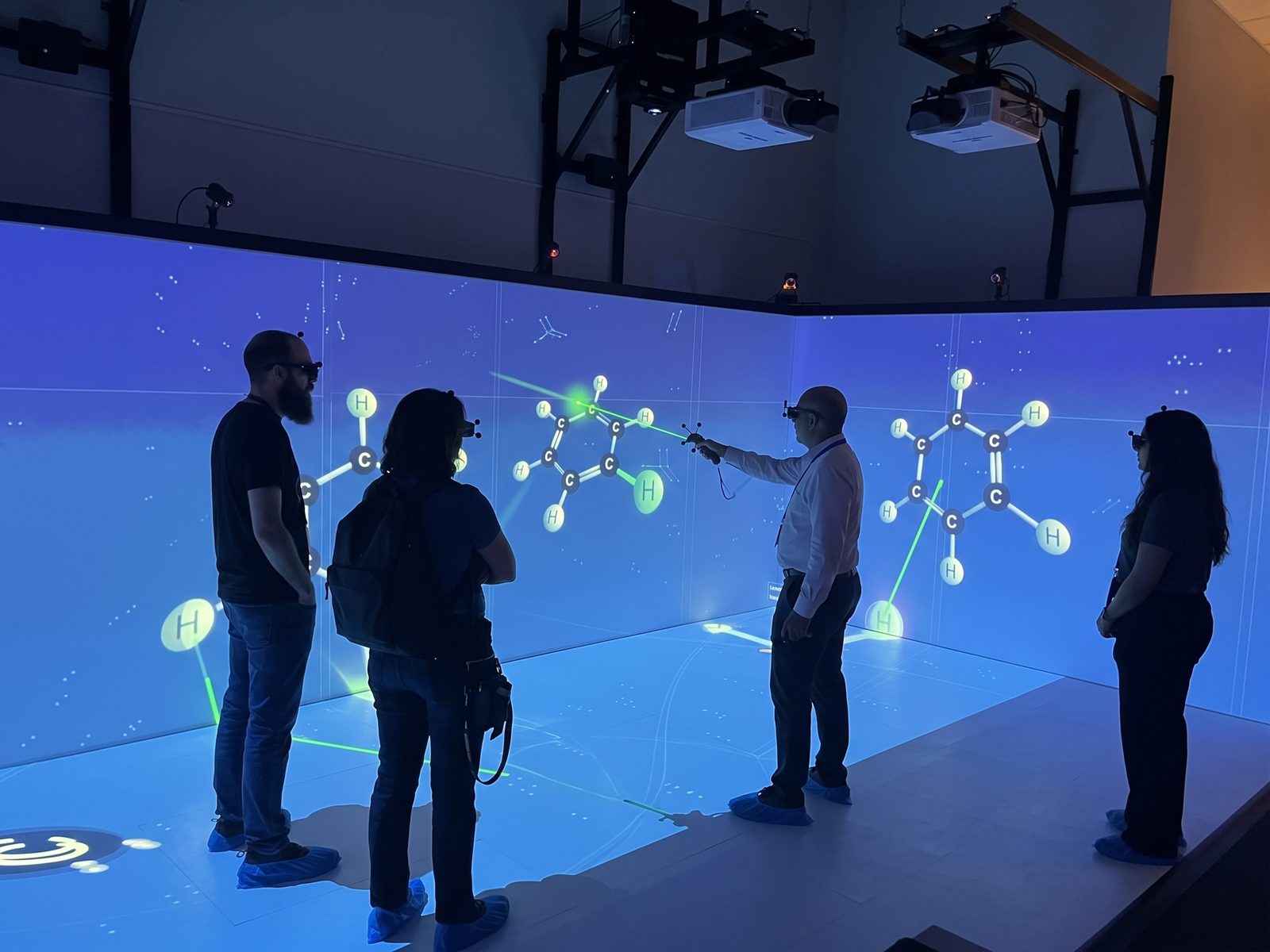
A fixed CAVE (Cave Automatic Virtual Environment), a room where projectors fill the walls and the floor with 3D images
Maker
Fakespace Systems Inc.
Setup
Four-wall 3D (stereo) projection, with four projectors and images on the floor too
Location
Room 157, Southern University, Baton Rouge
How people see it
Tracked 3D glasses, with a handheld controller to point at and move objects
Visitor rule
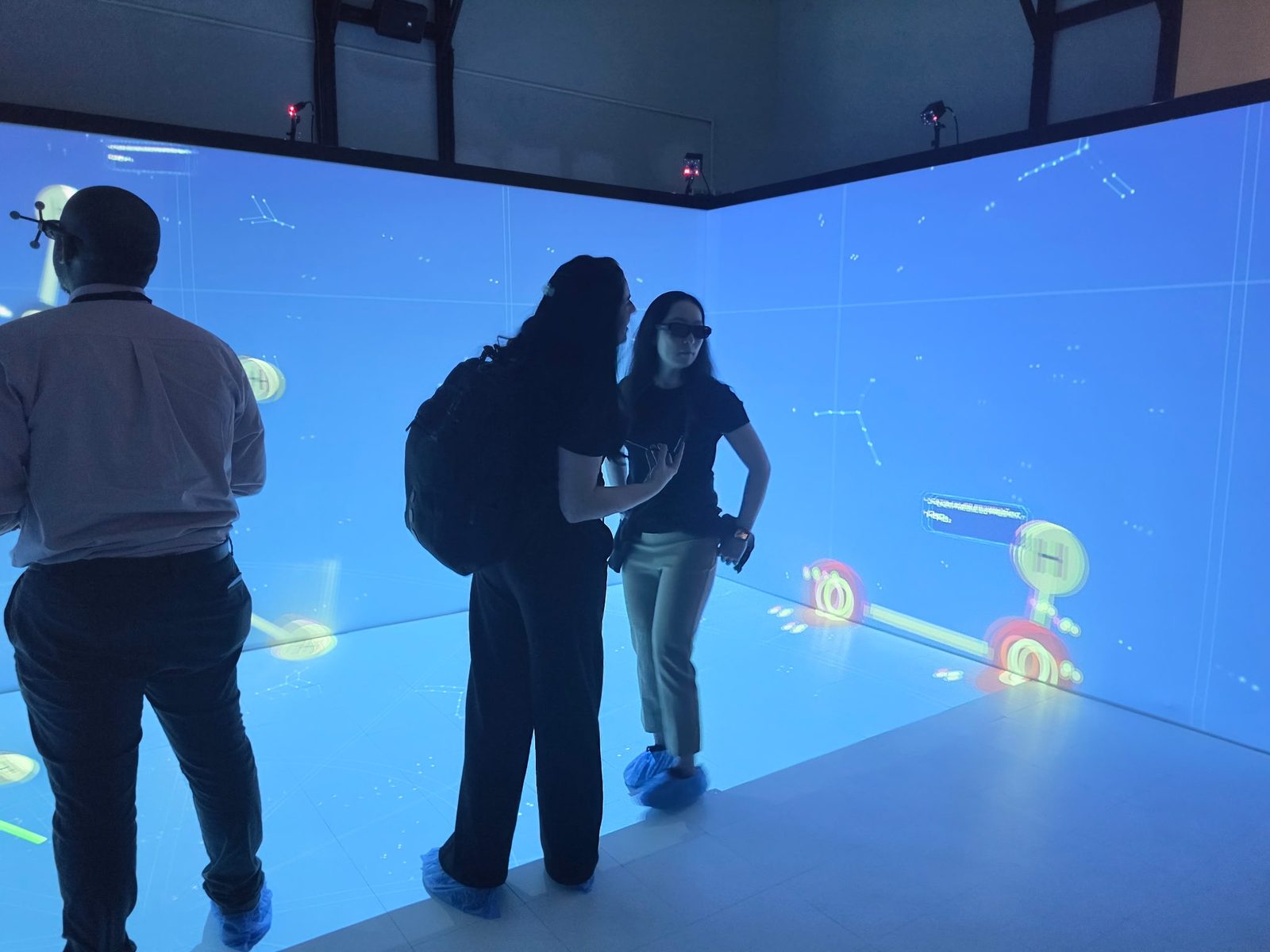
Keep your shoes on and put shoe covers over them before you step onto the projected floor
Partner unit
The Southern University Mobile CAVE, a CAVE on a truck, grand opening date to be announced
02
What it is
The stationary CAVE is a 3D projection room on Southern University's Baton Rouge campus. Several projectors throw matching images onto the walls and the floor around the people inside. Each person wears tracked 3D glasses, so the images appear in depth, as if the model is standing in the room with them. A guide at a control station runs the scene, and a handheld controller lets visitors point at an object and move it.
The CAVE idea comes from the Electronic Visualization Laboratory at the University of Illinois Chicago. Carolina Cruz-Neira, Daniel Sandin and Thomas DeFanti built the first CAVE there, and it debuted at the SIGGRAPH '92 conference. The name is a recursive acronym, CAVE Automatic Virtual Environment, and it also refers to the cave in Plato's Republic, a story about perception and reality. Fakespace Systems, the maker of Southern University's room, sold the CAVE commercially after the laboratory developed it.
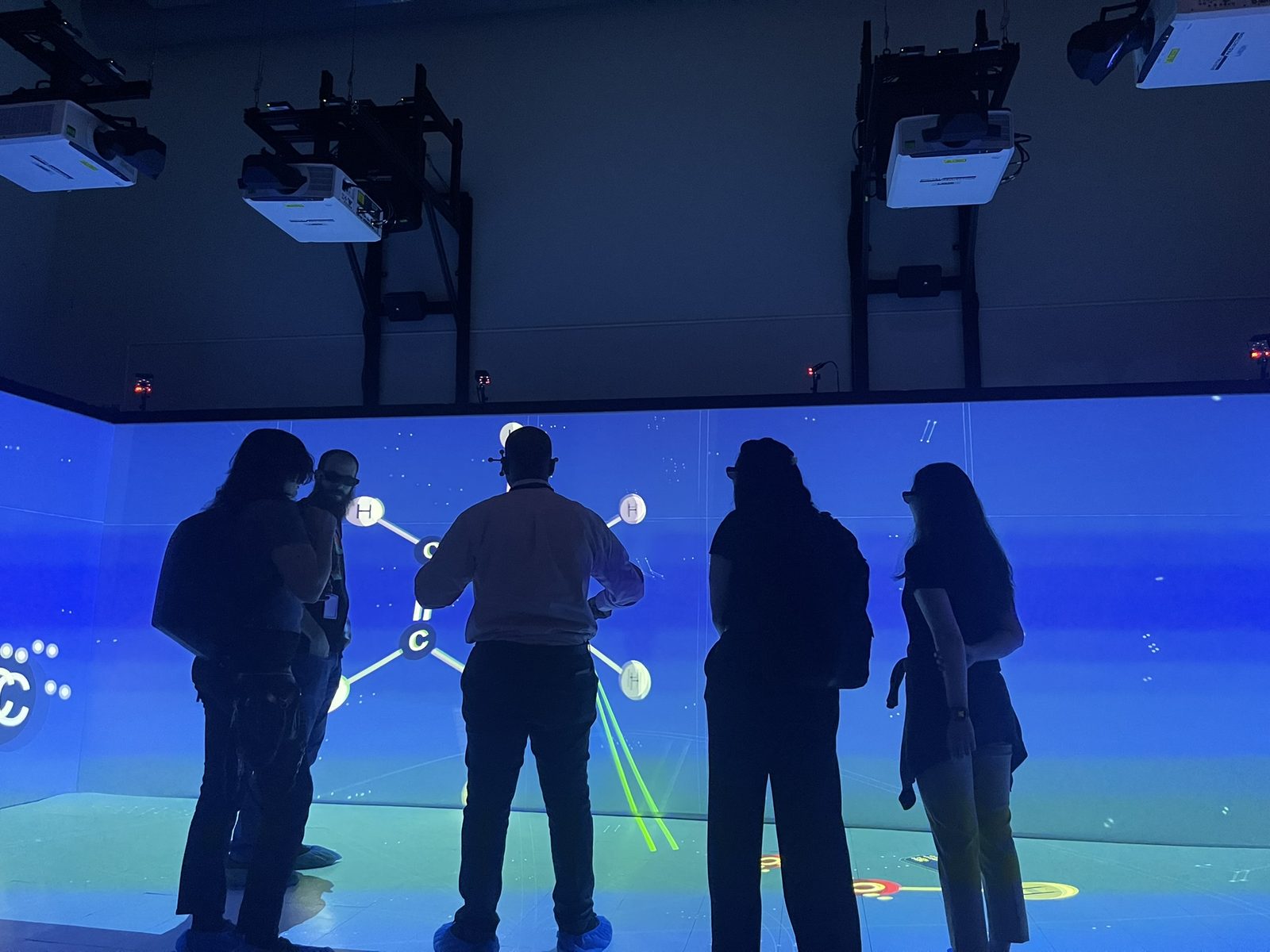
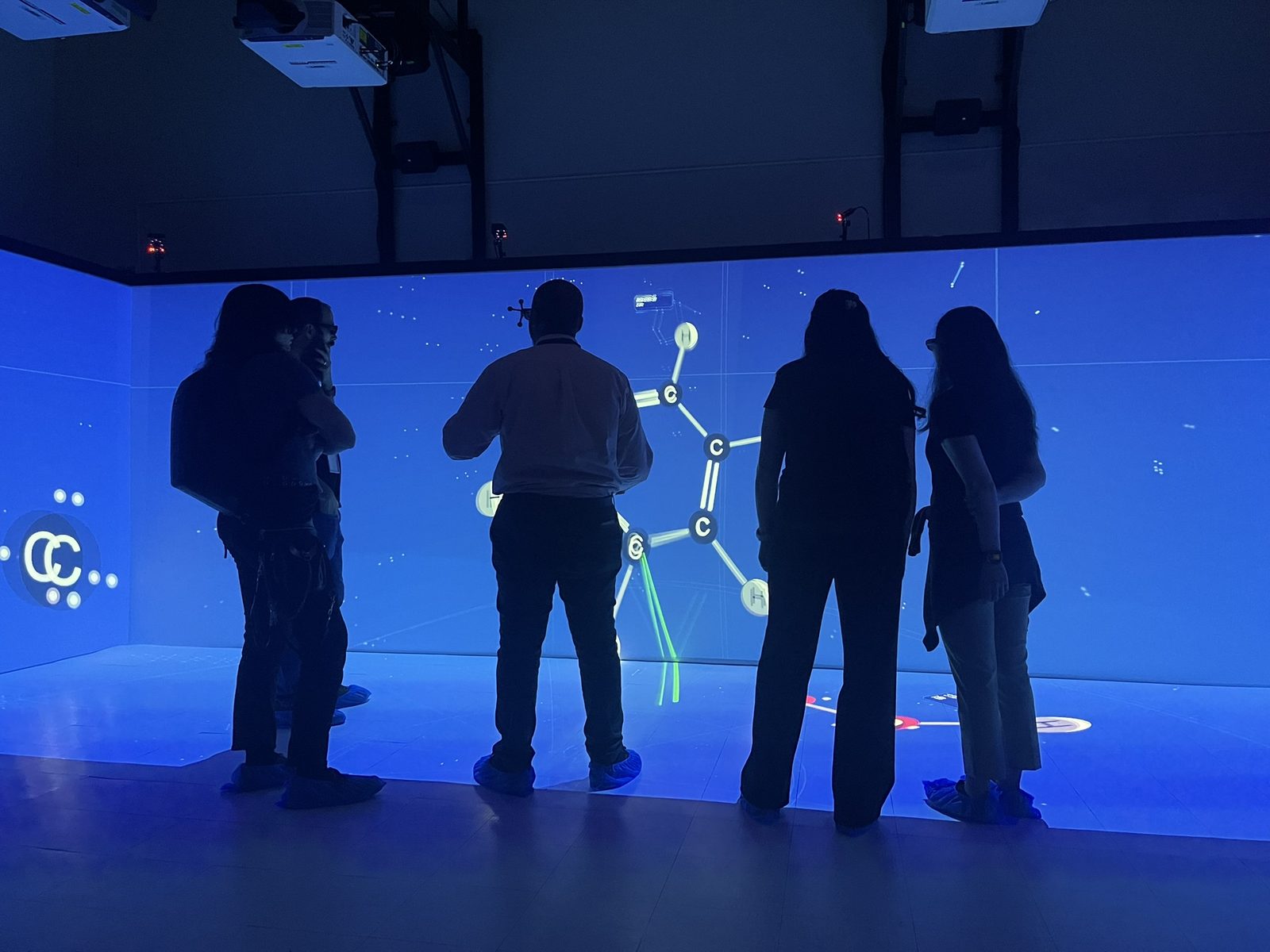
What sets a CAVE apart from a VR headset is that the room is shared. In a headset, each person is sealed inside their own view. In a CAVE, a group stands together, sees the same model, points at the same part and talks it through face to face. People keep sight of their own hands and of each other. That makes the room a place for discussion, design review and teaching, not only for one person's experience.
On the October 2026 visit, the room ran a chemistry demo: 3D molecules that filled the walls and the floor. That demo has its own deep dive (CAVE demo: chemistry molecules). This module covers the room itself: what it is, what it lets people do, and why it matters to Southern University's plans.
03
How it works
The floor is a projection surface, so it has to stay clean and unmarked. Every visitor keeps their shoes on and puts shoe covers over them before stepping in. Groups hear the rule before they arrive.
The projectors show two images at once, one for each eye. The glasses separate them, so the brain sees depth. Tracking lets the system follow the viewer's position, so the view shifts as the person moves, the way a real object looks different as you walk around it.
Four projectors cover the walls and the floor. The model surrounds the group instead of sitting on a screen in front of them. A molecule, a building or a machine takes up the space of the room.
A handheld controller works like a pointer. Visitors select a part of the model, move it and look at it from another side. In the molecule demo, visitors picked out atoms and explored how the pieces fit together.
A guide at the control station loads scenes and explains what the group is seeing. The guide can pause, zoom and change the view, so a class or a project team works through one idea at a time.
Lessons and scenes built for a CAVE can travel. The Mobile CAVE takes the same kind of 3D room to schools, plants and communities across Louisiana, while the stationary room stays on campus for research and advanced teaching.
04
Impact
A front-row seat for people who rarely get one
Expensive visualization rooms usually sit inside large research universities. Southern University is a public historically Black university, chartered in 1880 to educate Black Louisianans, and today it is the only HBCU system in the United States. A CAVE on this campus gives its students, and the schools and communities it serves, direct access to a tool that most people only read about.
Learning that works for more kinds of learners
Research backs the value of a shared 3D room for learning. In a 2020 study published in the International Journal of Educational Technology in Higher Education, students who learned neuroanatomy together in a CAVE showed significantly higher learning gains than students who used textbooks, with large effect sizes. The students with low spatial ability gained the most, reaching the level of their high spatial ability classmates. For a university whose mission is to widen access, that matters: the room helps close gaps between learners instead of widening them.
A pipeline into technical careers
HBCUs make up about 3% of U.S. colleges, yet they award 28% of the STEM bachelor's degrees earned by Black students, according to UNCF's 2026 report HBCUs Still Punching Above Their Weight. Every engineering, science and education student who learns in the CAVE adds to that pipeline. The skills they practice, reading a 3D model, explaining it to a team and making decisions from it, are the skills employers in manufacturing, energy and health care need.
A shared room for the community
The room is also a place to show the public what science looks like from the inside. Faculty use it for demos to visitors, and the same content feeds the Mobile CAVE's school and community visits. Parents, teachers and local leaders who step inside understand in minutes what a page of text cannot show.
A CAVE turns data into a place. A structure that is hard to grasp on a flat screen, such as a molecule, a machine or a building, becomes something a group can walk around. Because each person keeps sight of their own body and of the people beside them, the room supports the kind of conversation that design reviews and research meetings depend on.
The field has kept moving since 1992. Early CAVEs used rear-projection screens and electromagnetic tracking. Newer rooms use infrared camera tracking and, in some cases, large LED or LCD walls in place of projectors; the Electronic Visualization Laboratory released its LCD-based CAVE2 in 2012. Southern University's projection room connects its students to that line of development and to the national community of CAVE owners.
That community is organized. The CAAV (Campus Alliance for Advanced Visualization) keeps a list of immersive and large-display facilities and runs a national visualization network. Southern University hosted CAAVCon 2026 in Baton Rouge from October 13 to 16, 2026. The stationary CAVE is part of what put the university at the center of that conversation.
The room also links to the rest of Southern University's immersive work. Lessons and research tools built in the XR Development Studio can run in the CAVE, in classroom headsets and on the Mobile CAVE. One investment in content serves three kinds of rooms.
05
Why Southern University
Southern University already uses the CAVE for real teaching and research, not only for show. Faculty in the College of Sciences and Engineering and the Department of Science and Mathematics Education have run National Science Foundation-supported work that put first-year engineering students in the CAVE to learn cybersecurity and additive manufacturing concepts. That research, presented at the American Society for Engineering Education (ASEE) in 2024 and 2025, is covered in the Computational thinking research deep dive.
The university also built the next step: a CAVE that travels. The Southern University Mobile CAVE, presented with the CAAV, is getting ready to open. The stationary room is where content gets built, tested and studied; the truck carries it to people who cannot come to campus. Having both is rare, and it lets the university serve its campus and the whole state with one body of work.
The CAVE also fits Southern University's land-grant mission. Louisiana named Southern a land-grant college in 1890, with a duty to serve the state's people through teaching, research and outreach. A room that helps students learn, supports faculty research and opens its doors to schools and communities carries out all three parts of that mission.
06
Who it serves
Engineering and science students
Students walk around designs and models, spot problems before anything is built and practice explaining what they see to a team.
Faculty researchers
Researchers study how people learn in 3D and use the room to review complex data with colleagues.
Teacher candidates and K–12 classes
Future teachers and visiting classes see science at full size, which links the room to the Classroom VR and teacher training program.
Visitors, partners and funders
Industry partners, agencies and community groups step inside and see the work in action, which builds partnerships faster than slides do.
The Mobile CAVE team
The student-led team that runs the truck uses the campus room to build and rehearse scenes before they go on the road.
07
Why fund it now
The stationary CAVE is the anchor of a larger system that is opening right now. The Mobile CAVE is getting ready to launch, and its school, workforce and community visits depend on content and trained people. The campus CAVE is where both are developed. Support for the room now means the truck arrives in Louisiana communities with well-tested scenes and confident guides.
Funding keeps the room current and in use. It pays for the staff time to run sessions, the upkeep that keeps projectors and tracking reliable, and the development of new scenes for engineering, science and public-safety teaching. Each new scene serves the campus room, the Mobile CAVE and, through the XR Development Studio, classroom headsets.
Funding also grows the research. Southern University's ASEE work shows the room can be studied as a learning tool, and it points to larger, longer studies as the next step. A funded CAVE program gives faculty the time and the participants to run them.
08
How it connects
The stationary CAVE is where the chemistry molecule demo (CAVE demo: chemistry molecules) ran. It is the room used in the Computational thinking research study. Its scenes are built with the same tools as the XR Development Studio. It complements Classroom VR and teacher training, which puts a headset in each student's hands, by giving a whole group one shared space. On the Mobile CAVE side, it supports Exploratory research and advanced visualization (SP-04), which aligns with the CAAV National Visualization Network, and Student-led Mobile CAVE systems integration (SP-07), which runs the truck. The Vision module ties all of these together.
09
Questions funders ask
A headset gives one person a private view. A CAVE puts a group in one shared space where everyone sees the same model, sees each other and talks it through. Southern University uses both: headsets for individual lessons in classrooms, the CAVE for group work, research and demos.
Yes. A 2020 peer-reviewed study found significantly higher learning gains for students who learned neuroanatomy together in a CAVE than for students who used textbooks, and the largest gains came from students with low spatial ability. Southern University's own ASEE studies add evidence from its engineering students.
Students and faculty use it for classes and research. Visiting groups come by arrangement. Every visitor keeps shoes on and wears shoe covers on the projected floor.
They work as a pair. The campus room is for advanced teaching, research and building content. The truck takes 3D learning to schools, plants and communities that cannot travel to campus.
Operating time and staff to run sessions, upkeep of the projection and tracking system, and new scenes that serve the campus room, the truck and classroom headsets.
CAVEs and similar immersive rooms sit at universities and research centers nationwide. The CAAV keeps a list of these facilities, and Southern University hosted the CAAV's national conference, CAAVCon 2026, in October 2026.
10
Sources
- Cave automatic virtual environment (Wikipedia)
- The CAVE Virtual Reality System, Electronic Visualization Laboratory, University of Illinois Chicago
- Fakespace Systems, Inc., ACM SIGGRAPH History Archives
- Benefits of immersive collaborative learning in CAVE-based virtual reality (de Back et al., 2020)
- HBCUs make up just 3% of U.S. colleges but produce 28% of Black STEM graduates (theGrio, on the UNCF report)
- Southern University and Agricultural & Mechanical College (64 Parishes)
- Board 296: Immersive Engineering Learning and Workforce Development: Pushing the Boundaries of Knowledge Acquisition in a CAVE (ASEE 2024)
- Board 238: Exploring the impact of Knowledge Acquisition in a CAVE on engineering students' computational thinking skill levels (ASEE 2025)
- Southern receives $1.65M NSF grant to study cybersecurity for 3D printing (Southern University)
- Stationary CAVE, AM Lab site
- XR Jags
- Immersion in Motion: the Southern University Mobile CAVE