
01
At a glance
Sub-project code
SP-04 (CAAV-RES), one of seven sub-projects on the Southern University Mobile CAVE
Truck domain
exploratory research
Aligned program
CAAV National Visualization Network
The CAAV
the Campus Alliance for Advanced Visualization, a volunteer-driven nonprofit and information resource for higher education on immersive visualization
CAAVCon 2026
held October 13–16, 2026, at Southern University and A&M College, Baton Rouge
On campus
a four-wall Fakespace CAVE with floor projection in Room 157
Southern University
a Carnegie R2 high research institution since 2022
02
What it is
SP-04 makes the Mobile CAVE a research instrument. A CAVE is a room where several projectors show matching 3D images across the walls and floor around the viewer, so a whole group can stand inside a model and study it together. Researchers use that to see data and designs at full size: the structure of a molecule, the layout of a building, the flow of a storm, a network of connections that is unreadable on a flat screen. SP-04 takes that capability off campus, to partner universities, research sites, conferences and communities.
The sub-project is aligned with the CAAV National Visualization Network. The CAAV, the Campus Alliance for Advanced Visualization, describes itself as an information resource for higher education worldwide on immersive visualization platforms, advanced video screen formats, advanced visualization software, and the sustainability and operation of high-tech visualization facilities. It keeps the CAVE List of immersive and large-display facilities, runs an annual conference, and connects the people who build and operate these rooms.
That link matters. Southern University's Mobile CAVE is presented with the CAAV, and Southern hosted CAAVCon 2026 in Baton Rouge in October 2026, one month before the Mobile CAVE's grand opening. SP-04 connects a student-built mobile research room to a national community of researchers, faculty and facility staff who already know what these rooms can do.
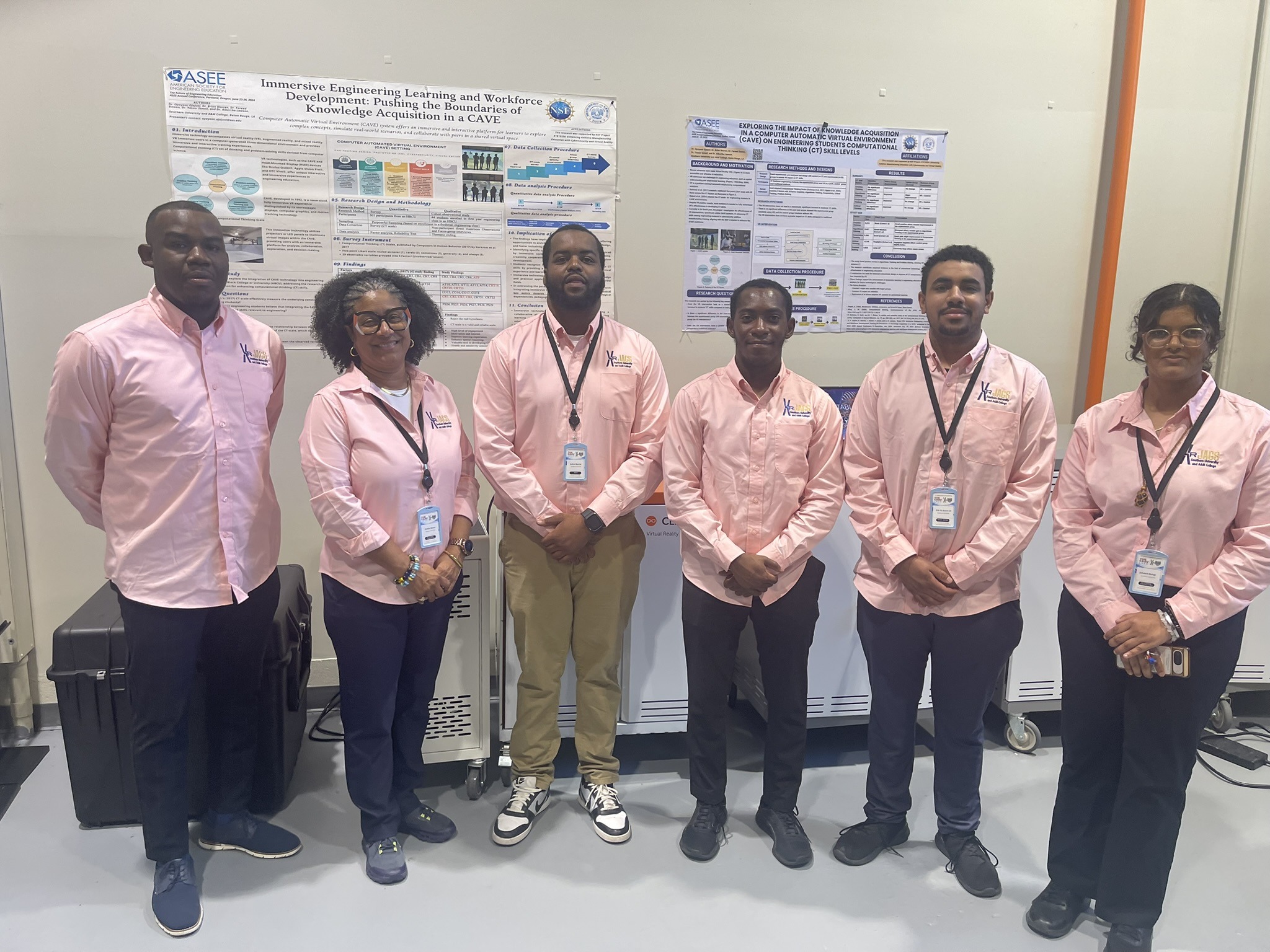
SP-04 is also where Southern studies how immersive learning works. The university's research group has presented ASEE posters on how learning in a CAVE affects engineering students' computational thinking, and on immersive engineering learning and workforce development. A mobile CAVE lets that kind of study reach students and settings beyond one campus room.
03
How it works
A faculty member, partner university, agency or company brings a question that needs to be seen in three dimensions: a dataset, a design, a model, or a study of how people learn or decide in an immersive setting.
The XR Development Studio prepares the data or model for 3D display, using the same build tools it uses for VR lessons, Unity and OpenXR, so a scene can run on headsets, in the stationary CAVE or in the truck.
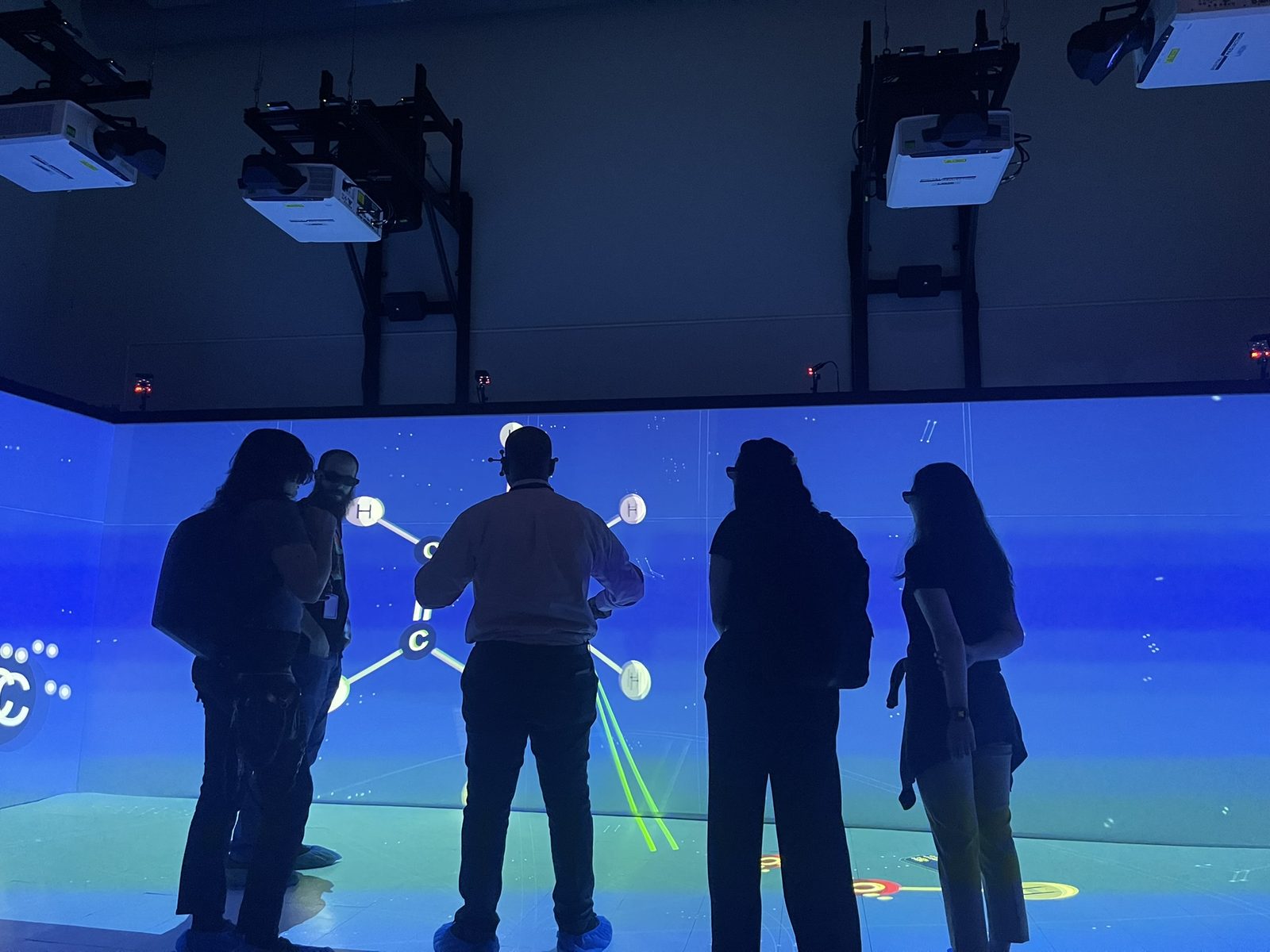
Participants keep their shoes on, put shoe covers over them, and put on tracked 3D glasses. The model fills the walls and floor around them. A handheld controller lets them point at parts, select objects and move them.
Because everyone stands in the same scene, the group can point, compare and argue about what they see. That shared view is what makes a CAVE useful for design review and team analysis.
Results, methods and lessons go back to the partner and, through the CAAV, to a community of people who run similar facilities: through its member Slack, its monthly connect day, its annual conference and its archived talks.
04
Impact
Bringing research-grade tools to people who rarely see them
CAVE rooms are expensive and fixed in place, usually at large research universities. A mobile CAVE presented with a national alliance brings that experience to HBCUs, community colleges, rural campuses and communities that have never had access to one. Researchers and students at those places get to do work that would otherwise require travel to a distant facility.
Growing Black researchers in visualization and engineering
Historically Black colleges and universities make up about 3% of U.S. colleges but award 28% of the STEM bachelor's degrees earned by Black students, according to a 2026 UNCF report. Southern University's College of Engineering is among the top ten producers of Black undergraduate engineering degree recipients. Students who help build, run and study a mobile CAVE gain research experience in a field where they are underrepresented.
A student-led research platform
The Mobile CAVE was conceived and led by Southern University students from concept to completion. SP-04 keeps students at the center of the research: building scenes, running sessions, collecting data and presenting results, as the research group has already done on ASEE posters.
Public outreach and competitions
The CAAV's charter includes professional development, mentoring and public outreach, including student demonstrations and competitions, and the alliance runs a Student AR/VR Design Competition. SP-04 gives Southern students a mobile stage for that work.
The CAVE was described by C. Cruz-Neira, D. Sandin, T. DeFanti, R. Kenyon and J. Hart, from the Electronic Visualization Laboratory at the University of Illinois Chicago, in Communications of the ACM in June 1992: a room whose surfaces surround the viewer with projected images, rendered from the viewer's position so the scene stays correct as they move. The idea that makes a CAVE useful for research has not changed: a group shares one immersive view.
Research comparing CAVE rooms and headsets helps explain why. In a study published in IEEE Transactions on Visualization and Computer Graphics, pairs of users analyzed 3D network visualizations either in a CAVE2 room or in head-mounted displays. Both platforms reached high accuracy, with no significant difference, but headset users rated their discussion as significantly more impersonal than CAVE users did. For research teams who need to talk while they look, the shared room matters.
For learning, a 2022 meta-analysis of 48 experiments in Educational Research Review found that immersive VR improved learning outcomes overall and that CAVE systems had a positive effect. The same analysis found the largest effects in engineering (g = 0.79) and architecture (g = 1.90), two fields where seeing a design at full size changes understanding.
A mobile CAVE extends all of this. Research that once had to happen in one room can travel to the people and places being studied, and the same 3D scenes can move between the truck, the stationary CAVE and headsets, because they are built with shared tools.
05
Why Southern University
Southern University already runs immersive research. It has a four-wall Fakespace CAVE with floor projection in Room 157, a second immersive room with stronger projection including the floor, a VR development studio, and a research group that has presented its CAVE learning studies at ASEE, the American Society for Engineering Education. One of those studies compares students who learn with VR and without it, measuring computational thinking and its link to final grades.
Southern is a research university. Its Baton Rouge campus was named a Carnegie R2 high research institution in 2022, and it is part of the only HBCU system in the United States.
Southern is at the center of the national visualization community this year. It hosted CAAVCon 2026, four days of presentations, panels and networking, in October 2026, and the Mobile CAVE is presented with the CAAV. Southern now combines a fixed CAVE, a mobile CAVE, a VR studio and a direct tie to the national alliance for the people who run them.
06
Who it serves
Faculty researchers
Engineers, scientists and education researchers study data, designs and learning in a shared 3D room, on campus or at a partner site.
Graduate and undergraduate students
Students build scenes, run sessions, collect data and present results, gaining research experience in immersive visualization.
Partner universities and colleges
Institutions without a CAVE host the truck for research sessions, joint studies and student demonstrations.
Visualization facility staff
People who run CAVEs and large-display rooms compare notes through the CAAV network and learn from a mobile build.
Agencies and industry partners
Organizations with complex data or designs test them at full size with Southern researchers.
K-12 and community audiences
Research scenes double as outreach, showing young people what research looks like from the inside, alongside SP-01.
07
Why fund it now
The timing is unique. Southern hosted CAAVCon 2026 in October, and the Mobile CAVE, presented with the CAAV, is getting ready to open. The national visualization community has just seen Southern's work up close. Funding now turns that visibility into lasting research partnerships.
The research base exists. Southern has a fixed CAVE, a second immersive room, a development studio, and a research group already publishing on CAVE learning. Funding builds on running work rather than starting from nothing.
Funding opens research to new places. A mobile CAVE lets partner institutions, especially HBCUs and smaller campuses, take part in immersive research without building their own room. Each funded study can include sites that would otherwise be left out.
Funding grows a workforce. Students who build and run research sessions in a CAVE learn 3D development, data visualization, systems integration and research methods, skills that carry into engineering, computing and education careers.
Funding produces shared knowledge. Through the CAAV network, methods and results reach facility staff and researchers nationwide, so each funded project benefits more than one campus.
08
How it connects
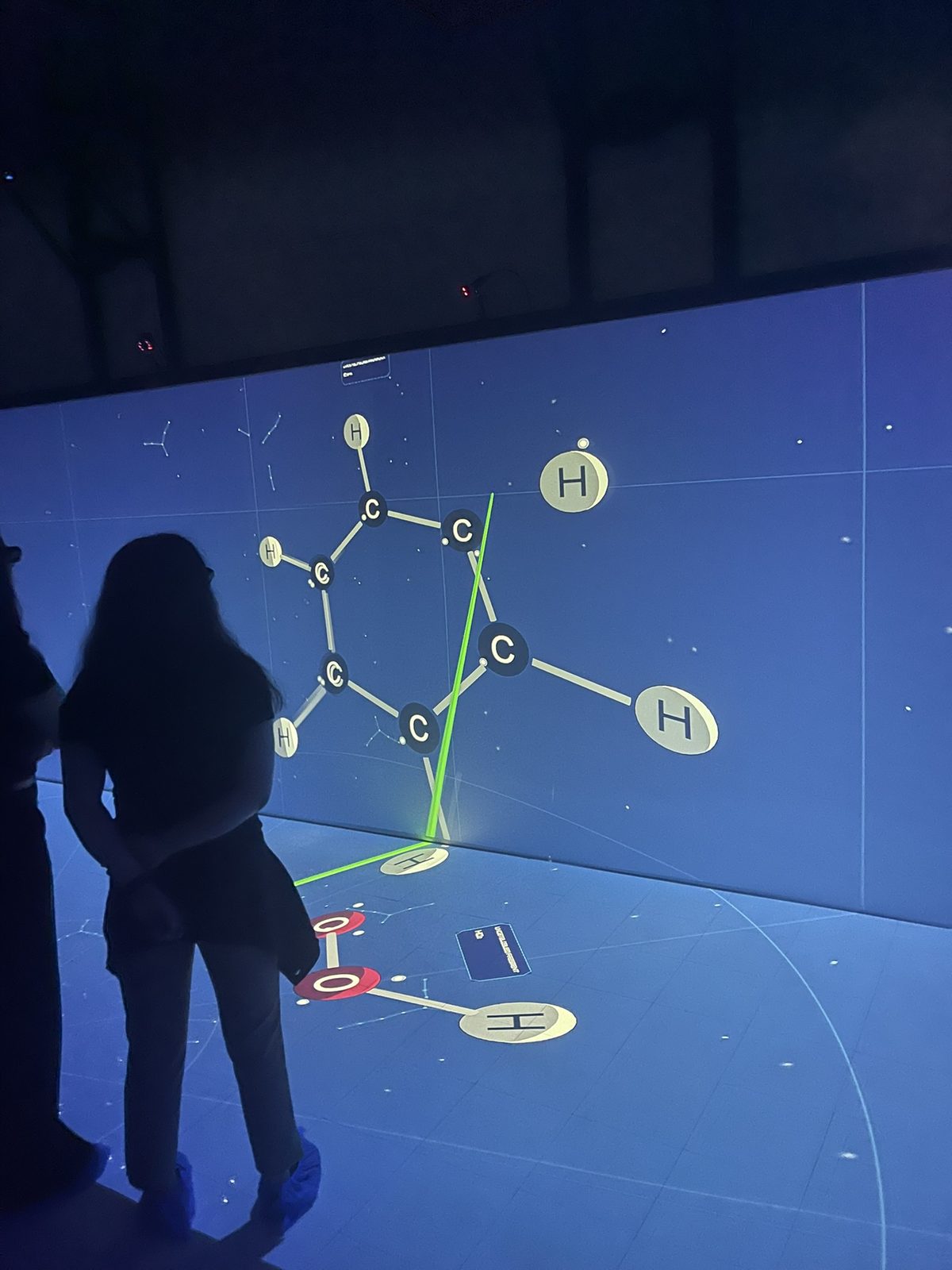
SP-04 is closely tied to the Stationary CAVE, the fixed four-wall room on campus where research scenes are developed and tested, and to Computational thinking research, the study of how VR affects students' problem-solving. The CAVE demo: chemistry molecules shows the kind of scene the room supports, and the XR Development Studio builds it. On the truck, SP-04 shares scenes with K-12 education and mobile STEAM outreach (SP-01) for outreach, and depends on Student-led Mobile CAVE systems integration (SP-07) for projection calibration and tour operations. The Vision module explains how the fixed rooms, the studio and the truck work as one system.
09
Questions funders ask
The Campus Alliance for Advanced Visualization, a volunteer-driven nonprofit and information resource for higher education on immersive visualization platforms, software and facility operations. It keeps the CAVE List and runs CAAVCon, its annual conference.
A CAVE lets a group stand in the same scene and talk face to face. Research comparing the two found similar accuracy, but headset users rated their discussion as more impersonal. SP-04 uses both, with the CAVE for shared analysis.
Southern's research group has presented ASEE posters on how a CAVE affects engineering students' computational thinking and on immersive engineering learning and workforce development. The computational thinking study compares VR and non-VR learners and links gains to final grades.
Faculty, students, partner institutions, agencies and companies with a question that needs to be seen in 3D. Sessions are arranged with Southern's project team.
Findings go back to the partner first and, through the CAAV network, to researchers and facility staff nationwide through its conference, talks and member community.
It has a fixed CAVE, a second immersive room, a VR studio, an active research group, R2 research status, and it hosted CAAVCon 2026. The Mobile CAVE adds a research room that travels.
10
Sources
- The CAAV, Campus Alliance for Advanced Visualization
- XR Jags (family site): about, conferences, CAVE List
- Cruz-Neira, Sandin, DeFanti, Kenyon & Hart (1992), The CAVE: Audio Visual Experience Automatic Virtual Environment, Communications of the ACM 35(6), Electronic Visualization Laboratory, UIC
- Cordeil et al., Immersive Collaborative Analysis of Network Connectivity: CAVE-style or Head-Mounted Display?, IEEE TVCG
- Coban, Bolat & Goksu (2022), The potential of immersive virtual reality to enhance learning: A meta-analysis, Educational Research Review 36
- HBCUs make up just 3% of U.S. colleges but produce 28% of Black STEM graduates, TheGrio, August 14, 2026 (UNCF report)
- Southern University and Agricultural & Mechanical College, 64 Parishes
- Stationary CAVE, AM Lab
- Computational thinking research, AM Lab
- Sub-projects, Immersion in Motion