01
At a glance
Sub-project code
SP-02 (ICLERT-CRISIS), one of seven sub-projects on the Southern University Mobile CAVE
Truck domain
emergency preparedness and crisis management
Aligned program
Immersive Crisis Leadership and Emergency Response Training (ICLERT)
What it offers
a crisis drill in 3D for parish leaders, emergency managers and responders, at their own site
Louisiana's exposure
17 federal disaster declarations in five years, five of them hurricanes
Grand opening of the Mobile CAVE
Southern University, Baton Rouge, date to be announced
02
What it is
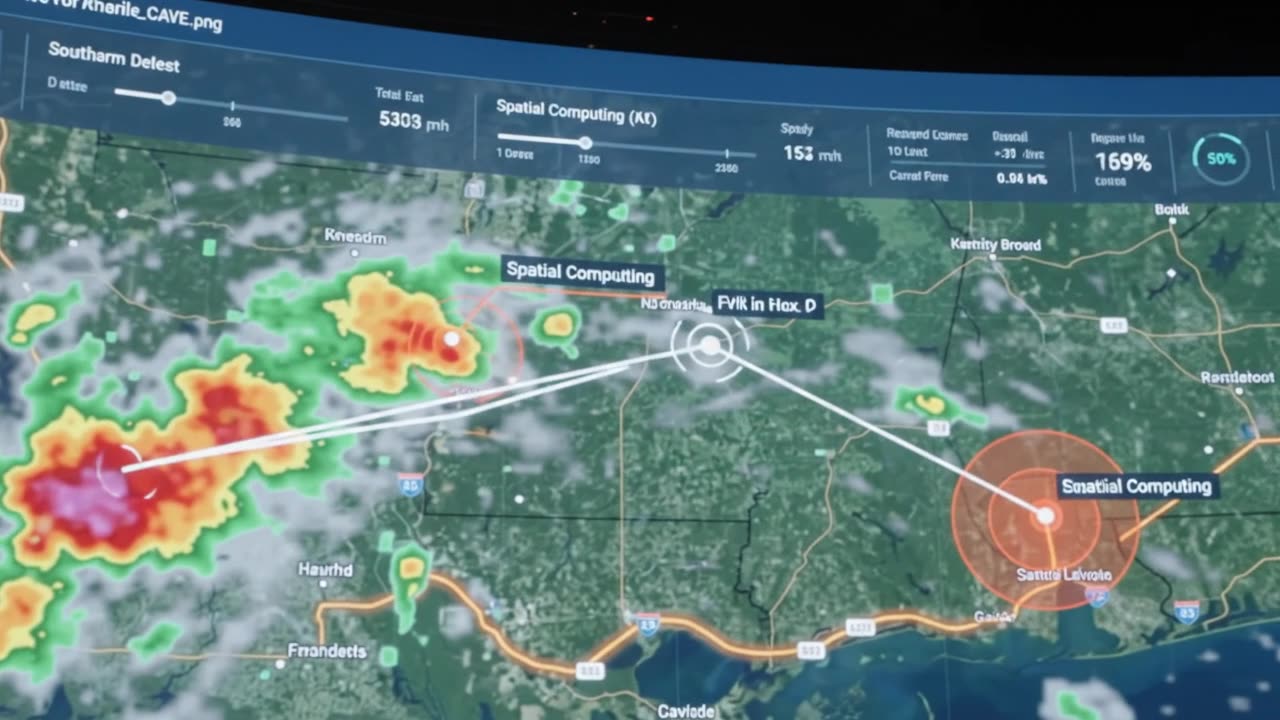
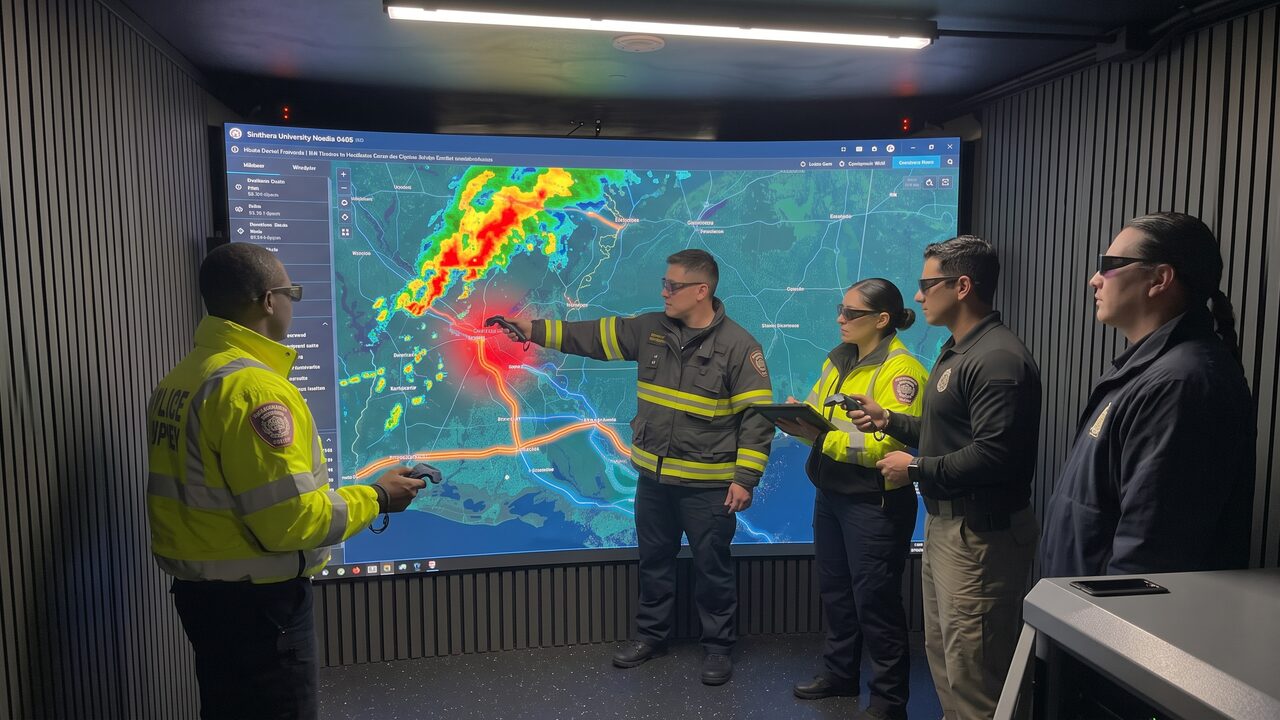
SP-02 turns the Mobile CAVE into a rehearsal room for emergencies. A parish emergency team, a fire department, a plant's response crew or a group of local officials steps inside a 3D scene of the event they are planning for: a hurricane making landfall, rising water in a neighborhood, a fire at a facility, a crowd that needs to move. They make the decisions they would make on the real day. The room shows the result. Then they talk it through and run it again.
The sub-project is aligned with Immersive Crisis Leadership and Emergency Response Training, known as ICLERT, a program listed by Southern University's immersive technology center. ICLERT's focus is in its name: leadership and response under pressure, trained in an immersive setting.
The core problem SP-02 solves is that emergency plans are tested rarely. Live exercises take people off duty, close roads or facilities, and cost a great deal to stage. Tabletop exercises are cheaper, but they ask leaders to imagine the scene around a table. SP-02 sits between the two. It gives leaders and responders a shared 3D picture of the event, at a fraction of the effort of a live drill, and it can be repeated as often as the team needs.
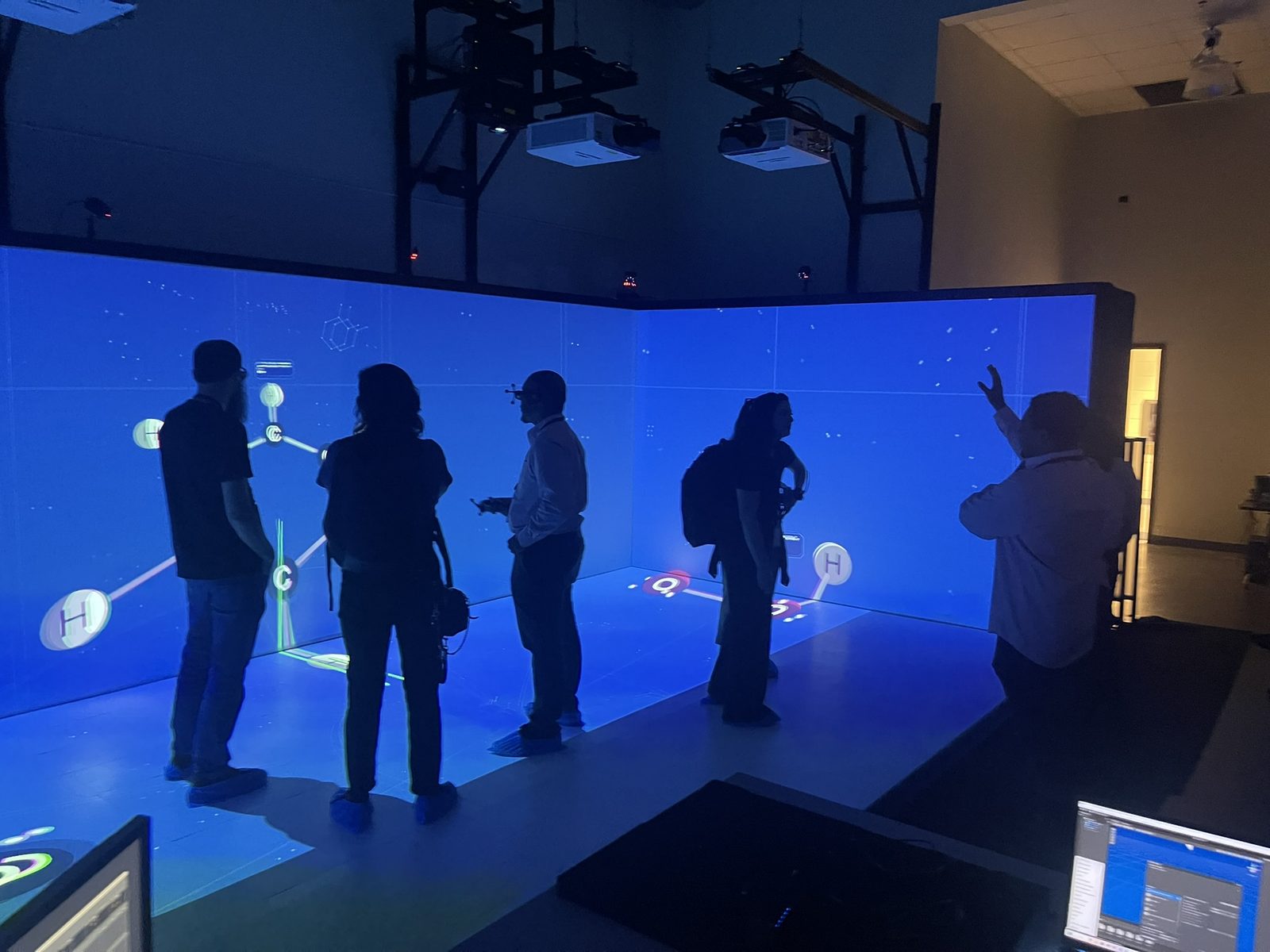
Southern University already runs a CAVE on campus, where groups stand inside a 3D scene with a guide. The Mobile CAVE brings that kind of room to the parish, the plant or the emergency operations center.
03
How it works
A parish, agency or company names the emergency it most needs to rehearse and the decision that is hardest to get right. The drill is built around that scenario, so the time spent is on the event the team actually faces.
A local partner opens its lot to the Mobile CAVE for the day. Parish officials, responders and community partners are invited. No one travels to a training center, and short sessions fit around shifts.
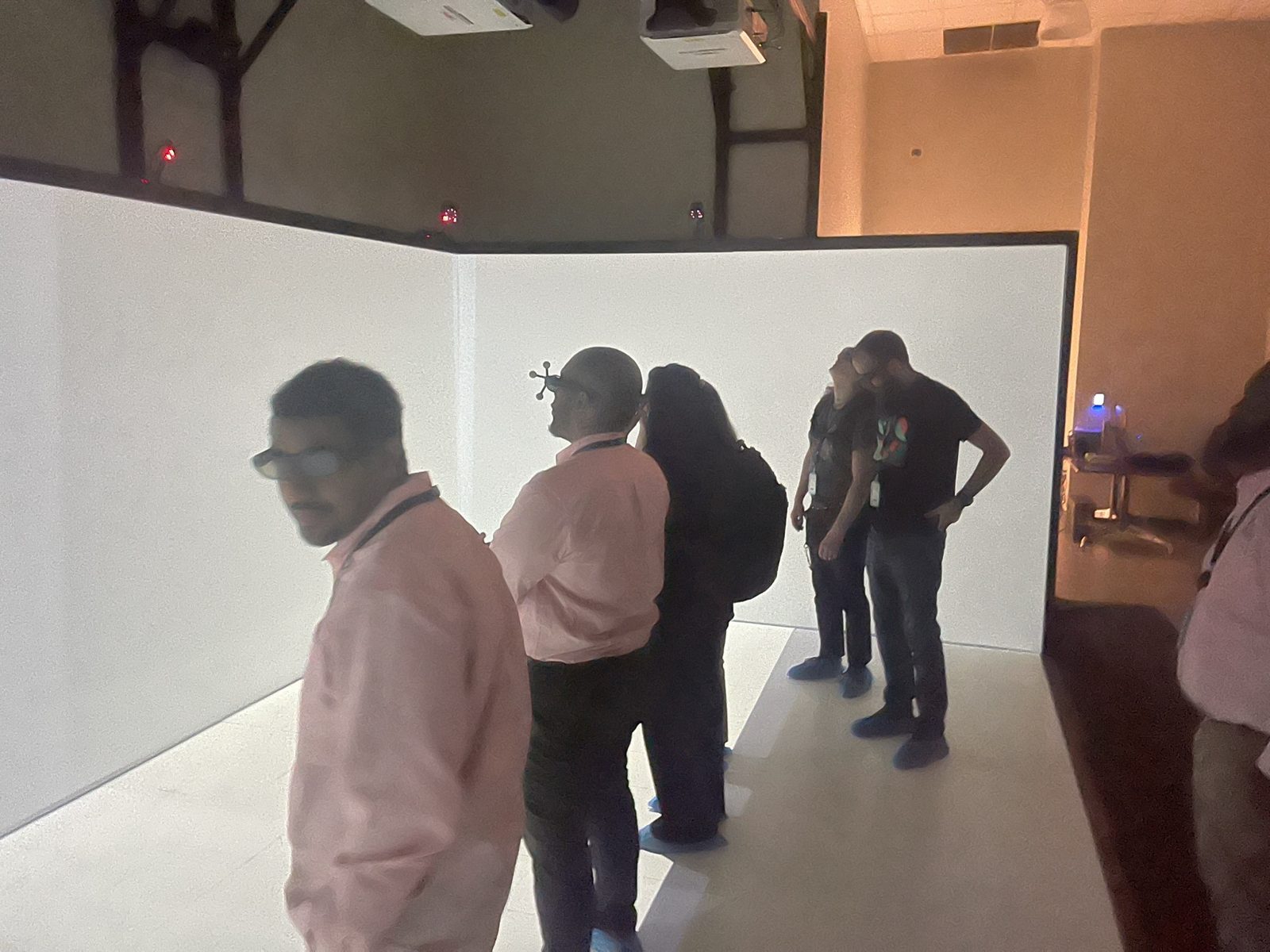
Each participant keeps their shoes on, puts shoe covers over them, and puts on 3D glasses. Inside, the scene surrounds the group on the walls and floor: the storm, the street, the facility. Everyone sees the same picture at the same time, which is what a command team needs.
The team makes its calls, where to send crews, when to close a road, how to move people, and the scene responds. A mistake in the room costs nothing. It becomes the lesson.
A guide replays the key moment and asks why the team made each call. The group runs the scene again, harder or different, until the response is automatic. Each organization names its top priorities, and findings are shared back with partners first.
04
Impact
A state that cannot afford to be unprepared
Louisiana has had 17 federal disaster declarations in the last five years, and hurricanes are the most common type. In 2020 alone, a record five named storms made landfall in Louisiana, including Hurricane Laura, which tied for the most powerful storm to hit the state on record and may have produced the highest storm surge ever recorded in Louisiana, about 20 feet in Cameron Parish. In 2021, Hurricane Ida made landfall near Port Fourchon as a Category 4 storm with 150 mph sustained winds, bringing catastrophic wind and surge damage to lower Lafourche and Terrebonne parishes. Every parish team that can rehearse its response more often is better prepared for the next one.
Rural parishes get the same training as cities
Fifty of Louisiana's 64 parishes are at least 92% rural. Rural emergency managers and volunteer responders are often farthest from training centers and have the least time to travel. A training room that drives to the parish closes that gap.
Leaders and responders train together
Crisis response fails at the seams between agencies. A shared 3D room puts the parish president, the sheriff's office, the fire chief, the hospital and the plant manager in the same scene at the same time. They practice the hand-offs, not just their own piece.
The public learns what a storm can do
The same scenes can show residents what storm surge and flooding look like before they arrive. People who have seen the water rise in 3D understand an evacuation order differently.
Immersive training has a growing evidence base in disaster preparedness. A 2024 scoping review in SAGE Open Medicine examined 55 studies of VR exercises for disaster preparedness and concluded that VR exercises "are more effective than tabletop exercises in planning for disaster preparedness training," while recommending VR also as a complement where tabletop remains in use. The review reports one comparison where tabletop training started slightly ahead on day one, but by day three the VR group reached 92% accuracy against 84% for tabletop.
Cost is part of the case. The same review reports one study in which a live drill cost about $229.79 per trainee and VR about $327.78 at first; after three years of repeated use, VR fell to about $115.43 per trainee while the live drill cost stayed the same. A training room that is built once and used many times becomes cheaper with every session. A mobile room spreads that cost across every parish it visits.
Public health agencies are testing the same approach. In a study published in BMJ Open, CDC emergency responders who used a VR response scenario overwhelmingly said others would benefit (97%), and most said it was representative of real response scenarios (72%) and that they would use lessons learned in the field (71%). The authors found VR "an acceptable training tool with data indicating high usability and excitement."
The CAVE format adds something headsets do not: a whole command team sees the same 3D scene together, with no one cut off behind a headset. Leaders can point, talk and decide as a group, the way they will on the real day. Scenes built in Southern University's XR Development Studio can also run on headsets for individual practice between truck visits.
05
Why Southern University
Southern University already lists the program SP-02 is built on. ICLERT, Immersive Crisis Leadership and Emergency Response Training, appears among the programs of the university's immersive technology center, alongside SURADD, the Louisiana Office of Public Health VR Project and its additive manufacturing work.
Southern also has the people. Its XR Development Studio builds VR applications with Unity and OpenXR, staff install and test them, and the studio already takes headsets and demonstrations to outreach events. The Mobile CAVE itself was conceived and led by Southern University students from concept to completion.
Southern is a Baton Rouge institution in a state where hurricanes are part of life. As a land-grant HBCU, its mission is service to the people of Louisiana, including the communities that have been hit hardest by storms and are often last to receive new resources.
06
Who it serves
Parish government and emergency management
Parish presidents, police juries and offices of emergency preparedness test their plans in 3D without the cost and disruption of a live exercise.
Fire, police and EMS
Responders rehearse their roles and the hand-offs between agencies in the same shared scene.
Industrial plants, utilities and ports
Facilities that must plan for fires, releases and storm damage run their emergency drills as often as needed, on their own site, without shutting down a line.
Hospitals and health systems
Emergency departments and incident command teams practice surge and evacuation scenarios. This links directly to SP-03, healthcare technology and public health VR.
Residents and community groups
Community nights and school visits show families what a storm can do and what preparedness looks like, before the season begins.
07
Why fund it now
The need is constant and growing. Hurricanes are the most frequent disaster type in Louisiana's recent federal declarations, and the state saw a record five named-storm landfalls in a single season in 2020. Every year a parish goes without rehearsing its plan is a year of risk.
The pieces are in place. The program exists, the stationary CAVE already runs guided 3D scenes on campus, and the Mobile CAVE is getting ready to open. Funding now decides how many parishes receive a crisis drill in the truck's first hurricane season and how many scenarios are built for them.
Funding makes training repeatable. The evidence shows VR exercises become cheaper per trainee the more they are reused, and a mobile room reuses the same scenes across many parishes. A sponsor that funds SP-02 builds a scenario library that serves the whole state for years.
Funding produces measurable results. Each stop starts with the organization's priorities, and findings are shared back with partners first. Southern's reporting rules record time spent practicing in a simulation separately from skills an instructor has checked, so funders see the difference between what was practiced and what was proven.
Funding strengthens the people who respond. The scenes can be used for leaders, responders and the public alike, so one investment reaches every level of the response.
08
How it connects
SP-02 builds on the Stationary CAVE, where guided group scenes already run on campus. Scenes are built in the XR Development Studio. On the truck, SP-02 works closely with Healthcare technology and public health VR (SP-03), since hospitals and public health agencies are central to any disaster response, and with Drone exploration and autonomous aerial systems (SP-06), whose reality capture and photogrammetry work can turn real places into 3D scenes for drills. Student-led Mobile CAVE systems integration (SP-07) keeps the truck ready for tour stops, including in storm season. The Vision module shows how all seven sub-projects share one truck.
09
Questions funders ask
No. It makes rehearsal frequent and affordable between live exercises. Teams practice decisions and hand-offs in 3D, then bring sharper plans to the live drill.
Yes. A 2024 scoping review of 55 studies concluded VR exercises are more effective than tabletop exercises for disaster preparedness planning, and CDC responders rated a VR response scenario as highly usable and representative of real response work.
It costs more to build at first and less to run over time. One study in the 2024 review found VR fell to about half the per-trainee cost of a live drill after three years of reuse. A mobile room spreads the cost across many parishes.
The scenario for each site is built or licensed with the partner before the demo. Each organization names its top priorities, and the drill is built around them.
Yes. A local partner hosts the truck in its lot for the day, and parish officials, responders and community partners are invited. The room comes to the parish.
Findings are shared back with partners first. Practice time in the simulation is recorded separately from skills an instructor has checked, and only totals are reported publicly.
10
Sources
- How many disasters are declared in Louisiana?, USAFacts
- Historic 2020 hurricane season comes to an end, Louisiana Radio Network, November 29, 2020
- Hurricane Ida, August 29, 2021, National Weather Service New Orleans/Baton Rouge
- Alshowair et al. (2024), Use of virtual reality exercises in disaster preparedness training: A scoping review, SAGE Open Medicine
- Bugli et al., Training the public health emergency response workforce: a mixed-methods approach to evaluating the virtual reality modality, BMJ Open
- Louisiana's rural health care anemic for minorities, poor, elderly, Louisiana Illuminator, November 18, 2022
- Cordeil et al., Immersive Collaborative Analysis of Network Connectivity: CAVE-style or Head-Mounted Display?, IEEE TVCG
- Southern University and Agricultural & Mechanical College, 64 Parishes
- XR Development Studio, AM Lab
- For rural councils, Immersion in Motion
- Sub-projects, Immersion in Motion