01
At a glance
Question
Does learning in VR, including in a CAVE, build computational thinking in engineering students?
Funding
National Science Foundation, Improving Undergraduate STEM Education (IUSE) award 1915520, "Enhancing Additive Manufacturing Education with Cybersecurity and Virtual Reality"
Award period
October 1, 2019 to September 30, 2024
Subjects
Cybersecurity and additive manufacturing (3D printing) in a first-year engineering course
Published
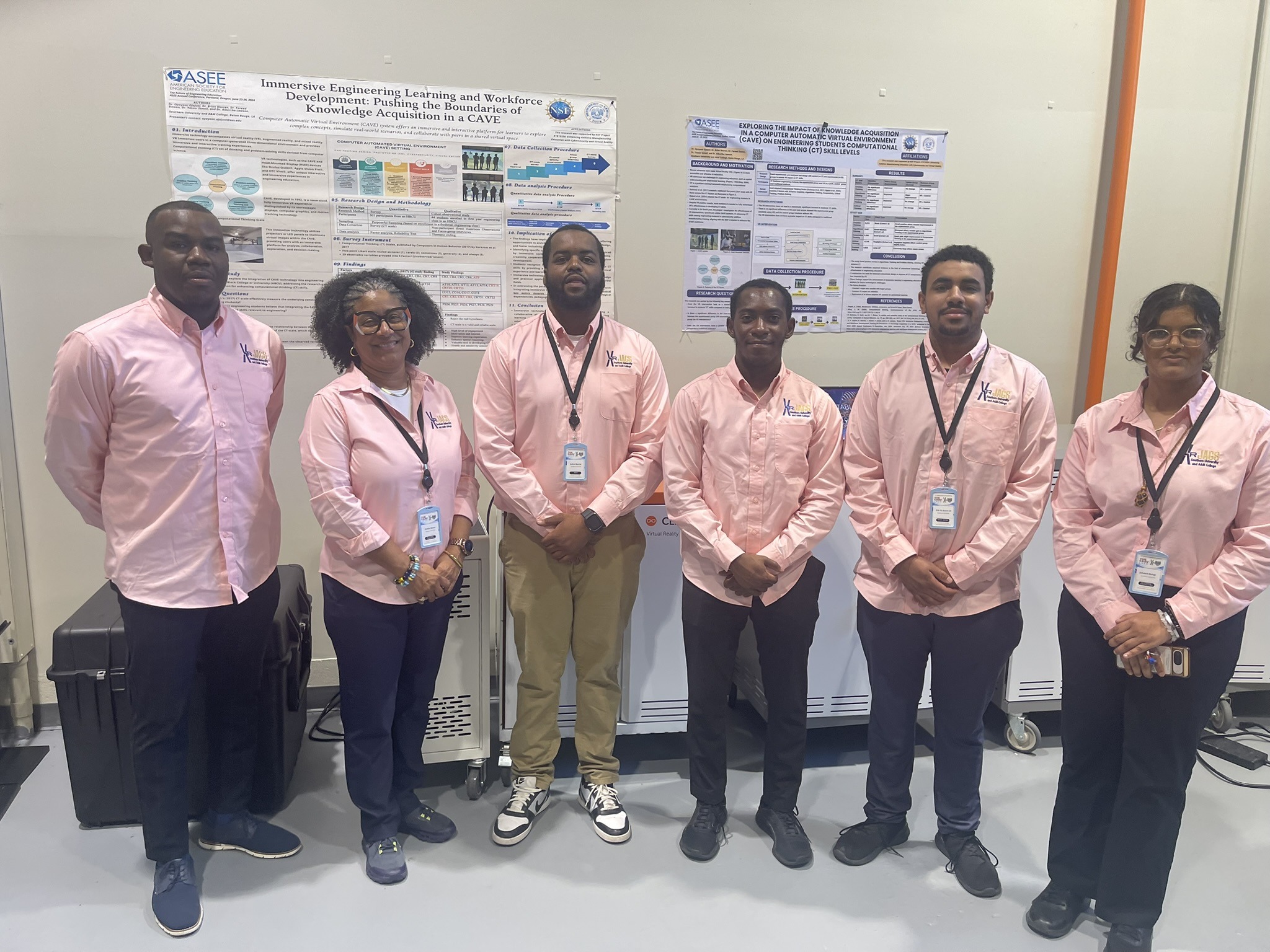
Posters at the ASEE Annual Conference in 2024 (Portland, Oregon) and 2025
Design
Validated a computational thinking scale with 301 students, then compared a CAVE group (20 students) with a traditional-instruction group (17 students)
Status
Final reporting phase
02
What it is
Computational thinking is a step-by-step way of solving problems: break a big problem into small parts, spot patterns, set aside details that do not change the answer and write steps that solve it every time. Jeannette Wing named the idea in a 2006 Communications of the ACM viewpoint and argued it would become "a fundamental skill used by everyone in the world by the middle of the 21st century," as basic as reading, writing and arithmetic.
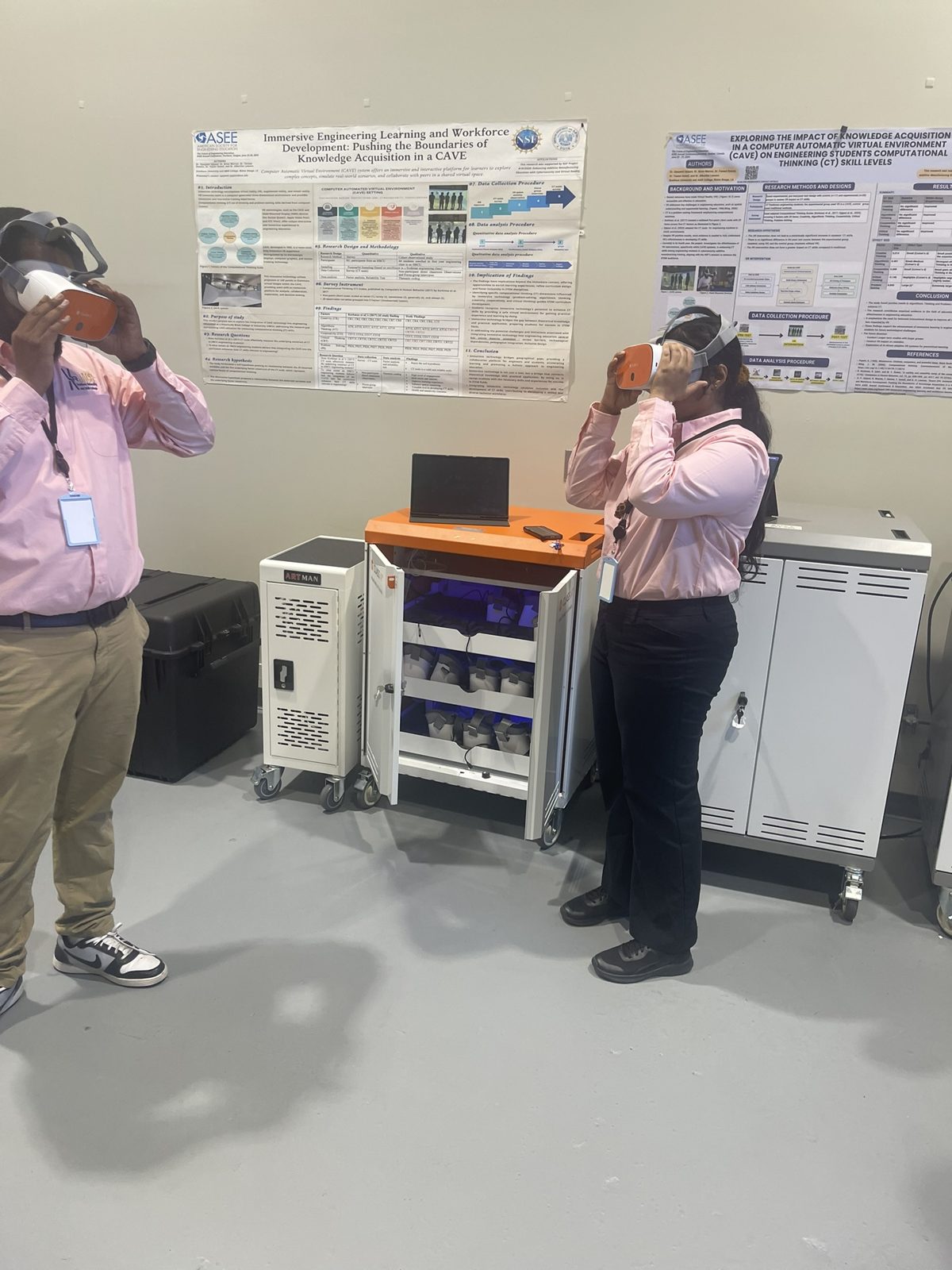
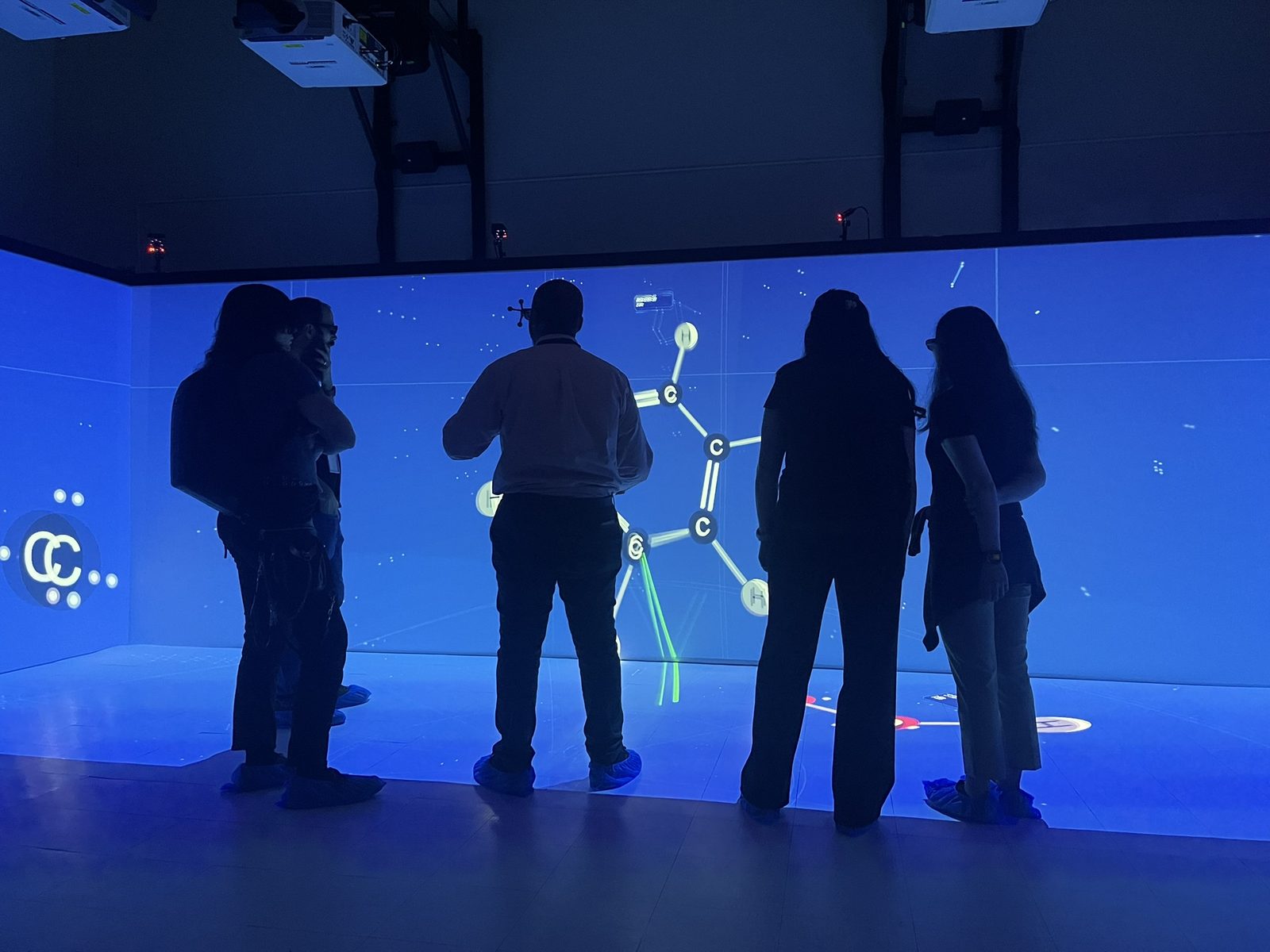
Southern University's research asks a practical question about that skill: does learning in virtual reality help engineering students build it? The setting is a first-year engineering course where students learn cybersecurity and additive manufacturing, a field where attackers can tamper with the digital files that drive 3D printers. Students first learn the material through traditional methods, with images and videos, and then work through the same lessons in a CAVE, where they can move objects and explore spaces in 3D.
The research is part of a National Science Foundation project, "Enhancing Additive Manufacturing Education with Cybersecurity and Virtual Reality" (award 1915520), funded through the Improving Undergraduate STEM Education program. The project builds a cybersecurity curriculum for additive manufacturing that uses VR, and it studies whether VR in that setting develops computational thinking. Southern University announced the NSF support in December 2019, naming Karen E. Crosby as principal investigator and Albertha Lawson, chair of the Department of Science and Mathematics Education, as the lead on the computational thinking study, with Penn State's Timothy Simpson among the co-investigators.
The study measures five parts of computational thinking. Creativity is coming up with new approaches. Algorithmic thinking is laying out the steps that solve a problem in order. Cooperativity is working through a problem with others. Critical thinking is judging which ideas and details actually matter. Problem solving is carrying a plan through to an answer. For an engineer securing a 3D printing workflow, each of these maps to real work: finding where a file could be altered, tracing how a change would show up in a printed part and agreeing with a team on the fix.
This is a separate project from Southern University's VR wellness research, which looks at stress and coping. This study is about problem-solving and engineering learning.
03
How it works
The team first had to show it could measure computational thinking well with Southern University's students. It adapted a published scale (Korkmaz and colleagues, 2017) with 29 items across five factors: creativity, algorithmic thinking, cooperativity, critical thinking and problem solving.
In the 2024 study, 301 first-year engineering students took the scale. Factor analysis supported the five-factor structure (KMO 0.909) and the scale showed high reliability (Cronbach's alpha 0.913), so the authors concluded it is valid and reliable for HBCU engineering students.
The same study added classroom observations and five focus groups with 44 students across three cohorts. Students described high engagement, motivation and interest, a better learning experience and stronger spatial reasoning. They also named comfort issues, including eye strain, dizziness and control sensitivity.
The 2025 study ran a quasi-experiment with pre-tests and post-tests. Twenty students learned with VR modules in the CAVE; seventeen learned through traditional instruction.
The team compared each group's change on the five parts of computational thinking and looked at how the gains relate to course outcomes.
The project is in its final reporting phase, with results shared through ASEE, the American Society for Engineering Education.
04
Impact
Evidence from HBCU classrooms
This study measures computational thinking in engineering students at a historically Black university and validates a scale for that setting. That gives HBCUs, and the agencies that fund them, evidence drawn from their own students instead of borrowed from elsewhere.
A stronger start in engineering
The study works with first-year engineering students, at the start of the engineering pipeline. HBCUs award 28% of the STEM bachelor's degrees earned by Black students while making up about 3% of U.S. colleges, according to UNCF's 2026 report. Teaching approaches that help first-year students build problem-solving skills strengthen that pipeline from its first step.
A workforce that can protect manufacturing
The NSF project responds to reports that manufacturing is a leading target for cyberattacks on infrastructure. Students who learn to spot tampered print files and think through threats step by step are the kind of engineers manufacturers need as factories go digital.
The study adds careful, honest evidence to a field that needs it. In the 2025 comparison, no change reached statistical significance (p > 0.05), and the authors name their small sample and the low internal consistency of the measure as limits. The direction of the results is still useful: the CAVE group showed small-to-medium positive effects in algorithmic thinking (Cohen's d = 0.538) and problem solving (Cohen's d = 0.557), small positive effects in creative and cooperative thinking, and little change in critical thinking. The authors call for more research to confirm these trends.
That pattern matches what other researchers see when they study immersive rooms. In a 2020 study, students who learned neuroanatomy together in a CAVE showed significantly higher learning gains than textbook learners, with large effect sizes, and students with low spatial ability gained the most. Southern University's students, in their own words, pointed to the same thing: stronger spatial reasoning and higher engagement.
The study also produced a tool others can use: a computational thinking scale tested with HBCU engineering students. A validated measure is the foundation for the larger, longer studies the authors recommend, at Southern University and at other campuses with CAVEs and VR labs.
05
Why Southern University
Southern University has the pieces this research needs in one place: a working CAVE on campus, an engineering program teaching additive manufacturing and cybersecurity, and a Department of Science and Mathematics Education with researchers who study how students learn. The NSF award brought those groups together, and the ASEE posters show the work in progress.
The university also has a reason to lead. Its additive manufacturing cybersecurity program was announced as the first of its kind at an HBCU, creating a cybersecurity "spine" in an engineering program. Studying how VR supports that curriculum is a natural next step.
The research feeds directly into Southern University's other immersive work. What the team learns about short, guided VR sessions, comfort and spatial reasoning shapes lessons in the XR Development Studio, sessions in the stationary CAVE and the programs the Mobile CAVE takes on the road.
06
Who it serves
First-year engineering students
Students learn cybersecurity and additive manufacturing concepts through VR and help shape how the course is taught.
Engineering and education faculty
Faculty gain a validated scale and real classroom evidence for deciding when and how to use VR.
Other HBCUs and universities
Campuses with CAVEs or VR labs can use the scale and the study design in their own courses.
Manufacturers and workforce partners
Employers gain graduates trained to think step by step about threats to digital manufacturing.
Funding agencies
Agencies see what VR instruction does and does not change, measured carefully, before they invest at larger scale.
07
Why fund it now
The groundwork is done. The team built and validated a measure, ran a first comparison and reported honestly on what it found. The authors' own recommendation is clear: larger experimental studies are needed to confirm the positive trends in algorithmic thinking and problem solving. Funding now pays for that next round, with more students, more cohorts and longer follow-up.
The timing matters because Southern University's immersive capacity is growing. The Mobile CAVE is getting ready to open, and the XR Development Studio keeps building new lessons. Research funding makes sure that growth is guided by evidence about what helps students learn.
Funding also addresses the comfort issues students reported. Eye strain, dizziness and control sensitivity are practical problems with practical fixes, such as shorter sessions and better controls, and a funded study can test them directly.
08
How it connects
The study runs in the Stationary CAVE and uses VR content of the kind built in the XR Development Studio. Its subject matter, additive manufacturing, links it to the Metal 3D printing lab and the Polymer 3D printing lab. Its findings on how students learn in VR inform Classroom VR and teacher training. On the Mobile CAVE side, it connects to Manufacturing technologies and cyber-additive XR (SP-05), which is aligned with the same NSF project, and to Exploratory research and advanced visualization (SP-04). The Vision module shows how research ties the whole system together.
09
Questions funders ask
The 2025 comparison found positive trends but no statistically significant change. Algorithmic thinking and problem solving showed small-to-medium effects (Cohen's d of 0.538 and 0.557). The authors call for larger studies to confirm them.
Because the results are honest and point in a clear direction. The study validated its measure, reported its limits and identified the skills most likely to benefit. That is the right base for a larger study.
Southern University faculty in the College of Sciences and Engineering and the Department of Science and Mathematics Education, with Albertha Lawson leading the computational thinking work. The ASEE posters list Opeyemi Peter Ojajuni, Brian Warren, Fareed Dawan, Yasser Ismail and Albertha Hilton Lawson as authors.
No. That is a separate project about stress and coping. This study is about problem-solving in engineering.
They reported high engagement, motivation and stronger spatial reasoning, along with comfort issues such as eye strain and dizziness.
Yes. The validated computational thinking scale and the study design are published through ASEE and can be used at other campuses.
In the study, students first learned from images and videos, then worked through the same lessons in the CAVE, where they could move objects and explore spaces in 3D. Students reported stronger spatial reasoning and higher engagement in the CAVE.
10
Sources
- Enhancing Additive Manufacturing Education with Cybersecurity and Virtual Reality, NSF DUE 1915520 (Grantome)
- Southern receives $1.65M NSF grant to study cybersecurity for 3D printing (Southern University)
- Board 296: Immersive Engineering Learning and Workforce Development: Pushing the Boundaries of Knowledge Acquisition in a CAVE (ASEE 2024)
- Full paper, ASEE 2024 (PDF)
- Board 238: Exploring the impact of Knowledge Acquisition in a CAVE on engineering students' computational thinking skill levels (ASEE 2025)
- Computational thinking, 10 years later (Jeannette Wing, Microsoft Research)
- Benefits of immersive collaborative learning in CAVE-based virtual reality (de Back et al., 2020)
- HBCUs make up just 3% of U.S. colleges but produce 28% of Black STEM graduates (theGrio, on the UNCF report)
- Computational thinking research, AM Lab site
- Sub-projects, Immersion in Motion