01
At a glance
What it is
Southern University's studio for building, testing and running virtual reality lessons and research tools.
Headsets
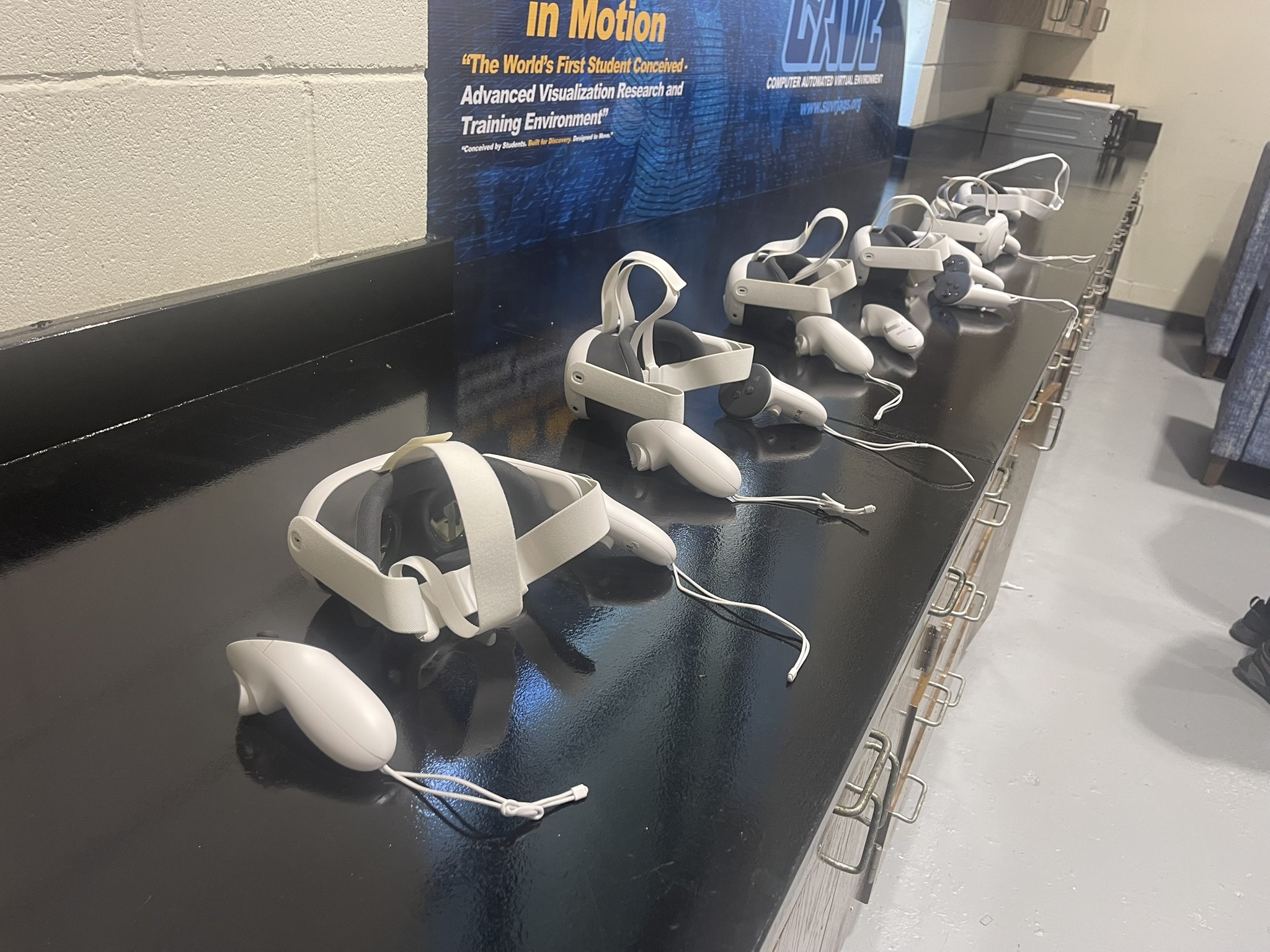
a fleet of Meta Quest and ClassVR headsets for lessons, research and events, with ClassVR carts that charge and carry a full class set.
Build tools
Unity (build engine), OpenXR (headset standard), Unity XR Interaction Toolkit, Unity Universal Render Pipeline and Unity Version Control; Meta Quest 3 for one research app.
People
staff who install and test VR apps on the headsets, and the XR JAGS student team.
Services the center lists
XR app development, 3D printing and rapid prototyping, reality capture and workforce training.
Programs the center lists
SURADD, ICLERT, the Louisiana Office of Public Health VR Project, and Enhancing Additive Manufacturing Education with Cybersecurity and VR.
Access
outside groups can ask for a demo by appointment.
02
What it is
The XR Development Studio is the workshop behind every virtual experience on the pathway. When a learner names the parts of a 3D printer in a headset, runs a simulated print job in the Mobile CAVE, or a teacher candidate leads a VR science lesson, the lesson came from a studio like this one. "XR" stands for extended reality, the umbrella term for virtual, augmented and mixed reality.
The studio has four parts. First, a fleet of VR headsets: Meta Quest headsets and ClassVR headsets, stored and charged in rolling carts so a full class set can move to a classroom or event. Second, build workstations: computers for building and testing VR apps. Third, staff who install and test the apps on the headsets so they work when a class or visitor puts them on. Fourth, readiness to deploy: apps go out to lectures, research, classrooms and community events.
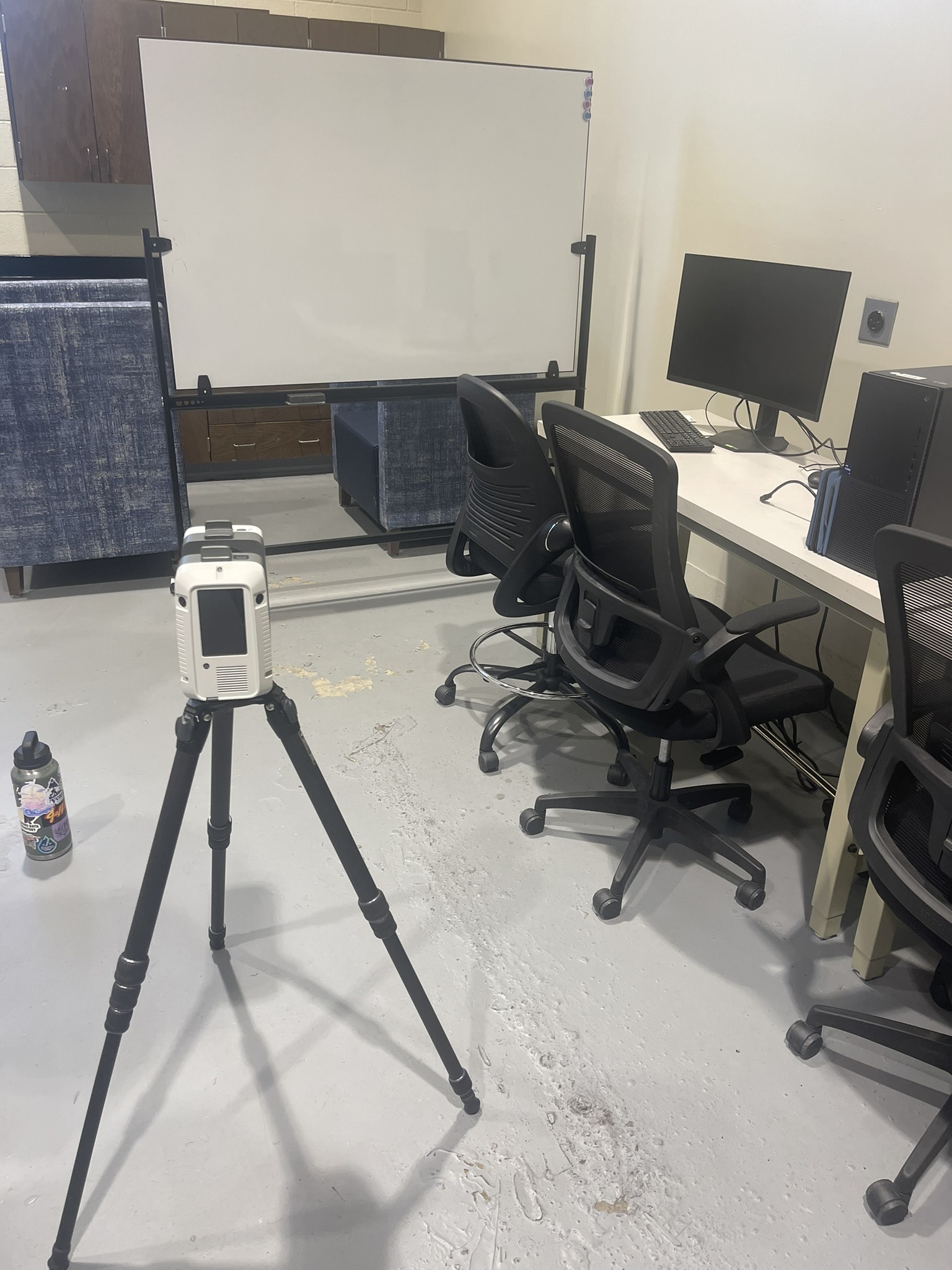
The studio also captures the real world. A 3D scanner on a tripod and a build workstation support reality capture, turning real rooms and objects into 3D models that can be used inside VR lessons. That lets the studio build lessons around the actual equipment and places learners will work with.
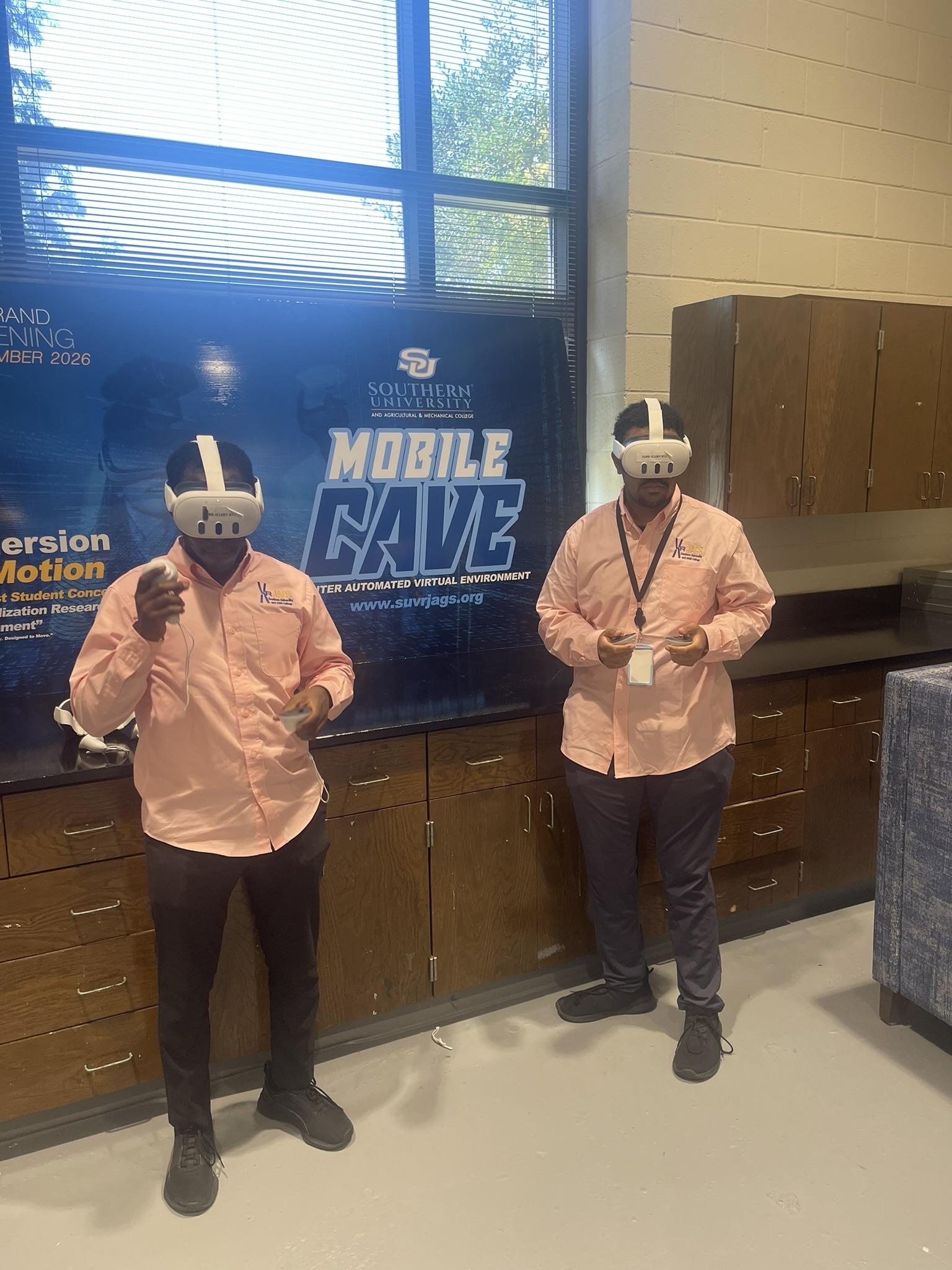
The XR JAGS student team works alongside the studio, testing headsets and running demonstrations. Students are not only users of the technology here; they are part of building and delivering it.
03
How it works
Faculty and researchers can ask for VR apps made for their own teaching or research. A request might be a lesson on a piece of equipment, a scenario for a research study or a training exercise for a workforce program.
The studio models the objects and spaces the lesson needs. Reality capture with a 3D scanner turns a real room or object into a 3D model. The AM Lab prototype used Blender for 3D modeling, Unity 2022 for the application, XR interaction tools and OpenXR.
Lessons are built in Unity, with the Unity XR Interaction Toolkit for hand and controller interaction and the Universal Render Pipeline for graphics. OpenXR, an open, royalty-free standard released by the Khronos Group in 2019, lets one application run across many VR and AR devices through a common interface. That is why the AM Lab printer modules run both on Meta Quest headsets and in a CAVE-style environment.
Staff install the apps on the headsets and test them. Unity Version Control keeps track of every version so changes can be tested and rolled back safely.
Finished apps go out to lectures, research studies, K–12 classrooms through the ClassVR carts, community events, and the stationary and Mobile CAVE rooms. Rugged travel cases carry studio gear to events and visits.
Research studies, such as Southern University's computational thinking work in the CAVE, use the studio's tools and feed findings back into how lessons are designed.
04
Impact
Training that would otherwise be out of reach
Many kinds of training are expensive, dangerous or impossible to repeat in real life: running industrial equipment, responding to a crisis, practicing a medical procedure. A 2021 meta-analysis in Human Factors found that VR, AR and mixed reality training performs about as well as traditional training, and that its main value is where traditional training is impractical because of danger or cost. The studio builds exactly those experiences.
Closing the digital divide
Through SURADD (Southern University Reaching Across the Digital Divide), the university received $6.2 million from the U.S. Department of Commerce's Connecting Minority Communities program in 2023 for VR equipment and connectivity. SURADD builds a K–12 workforce pipeline by engaging middle school teacher candidates, clinical educators, and university faculty and students with interactive VR spaces for instruction and workforce training. The studio's headsets and lessons are what make that possible in practice.
Public health and emergency response
The center lists ICLERT (Immersive Crisis Leadership and Emergency Response Training) and the Louisiana Office of Public Health VR Project among its programs. VR lets responders and health workers rehearse scenarios that cannot be staged safely or often in real life.
Students who build technology
The XR JAGS team gives students hands-on experience building and delivering immersive technology, a skill set that applies across games, simulation, engineering, healthcare and training industries. An HBCU studio where students build the tools widens who enters that field.
Building once, delivering everywhere
Because the studio builds on Unity and OpenXR, a lesson built once can run on headsets in a classroom and in the CAVE rooms. That makes each lesson more valuable: the same work serves a K–12 class, a university course and a Mobile CAVE visit to a plant.
Training that pays off at scale
PwC's study of VR training found learners finished up to four times faster than classroom learners and were up to 275% more confident applying what they learned. PwC also found that VR content can cost up to 48% more to build at first, but reaches cost parity with classroom training at 375 learners and becomes 52% more cost-effective at 3,000 learners. A studio that builds content for many programs and many audiences is how those learner numbers are reached.
Reality capture
3D scanning turns real equipment and spaces into accurate models. For training, that means lessons built around the machines and rooms learners will actually use, not generic stand-ins.
Immersive research
VR supports studies of decisions, learning and how people respond in a scenario. Southern University's published CAVE research with 301 engineering students validated a computational thinking survey for HBCU students and recorded high engagement, motivation and collaboration in the CAVE, while also noting student reports of eye strain and dizziness. Honest measurement like that guides better design.
Security built into the curriculum
The center lists "Enhancing Additive Manufacturing Education with Cybersecurity and VR," the NSF-funded project (award DUE 1915520, $1.65 million) that uses VR to show students how cyberattacks on 3D printer files can change printed parts. The studio is where that kind of lesson is built.
05
Why Southern University
Funded programs already running through VR
SURADD, ICLERT, the Office of Public Health VR Project and the additive manufacturing project are all listed programs. Several are also Mobile CAVE sub-projects. The studio serves a real, funded program portfolio, not a hypothetical one.
A research base
Southern University faculty have published immersive learning research at the American Society for Engineering Education, including a 2024 study of knowledge acquisition in a CAVE with first-year engineering students. The studio's work is grounded in that research.
A student-built culture
The Mobile CAVE is described on its banner as the world's first student-conceived advanced visualization research and training environment. The XR JAGS team continues that tradition in the studio.
The center of the pathway
The studio connects every other piece: it builds the AM Lab printer modules, the lessons for the CAVE rooms, the classroom VR content and the scenarios for research. Investment here multiplies across all of them.
06
Who it serves
Faculty and researchers
Anyone at the university who needs a custom VR app for teaching or research.
Students
Students who learn through VR lessons, and XR JAGS team members who build and deliver them.
K–12 teachers and students
Teacher candidates and classroom teachers who use ClassVR headsets and lessons, through SURADD and the classroom VR program.
Workforce and industry partners
Programs and employers that need simulations of job steps, work settings and technical skills, delivered on headsets or in the Mobile CAVE.
Public agencies
Public health and emergency response partners using VR scenarios through programs like ICLERT and the OPH VR Project.
Community groups
Organizations that request a demo or host the studio's headsets at outreach events.
07
Why fund it now
Every new lesson starts here. The AM Lab has two VR modules today, Printer Components and Print Job Operations, out of an eight-module track. Building the remaining simulations, print preparation, safety and quality control, requires studio time, developers and testing.
The Mobile CAVE is getting ready to open. Each of its eight fields needs content. The studio is the place that content is built and maintained, and support now determines how much is ready as visits begin.
Headsets need care. A fleet of Meta Quest and ClassVR headsets needs staff to install, update, test and repair them, and to keep carts charged and ready. Without that support, equipment sits unused.
Funding multiplies. Because the studio builds on open standards and serves many programs, each funded lesson reaches more learners across classrooms, campus CAVE rooms and the Mobile CAVE, which is how VR training becomes more cost-effective than classroom training over time.
08
How it connects
The studio builds the content the rest of the pathway runs on. It created the AM Lab printer modules used in the Polymer 3D printing lab track, and its lessons play in the Stationary CAVE and the Mobile CAVE. Its ClassVR carts power Classroom VR and teacher training, and its tools support Computational thinking research and the CAVE demo: chemistry molecules. On the road, it supplies the Mobile CAVE sub-projects, including Manufacturing technologies and cyber-additive XR and Student-led Mobile CAVE systems integration. The Vision document shows how the studio anchors the full pathway.
09
Questions funders ask
Custom VR apps for teaching and research, deployed to headsets, classrooms, community events and CAVE rooms. The AM Lab printer modules are one example.
OpenXR is an open, royalty-free standard that lets one application run on many devices. Building on it means a lesson works on headsets and in the CAVE, and is not locked to one vendor.
Faculty and researchers can ask for VR apps for their teaching or research, and outside groups can request a demo by appointment.
A 2021 meta-analysis found immersive training performs about as well as traditional training and is most valuable where real practice is dangerous or costly. PwC found VR learners trained up to four times faster than classroom learners. Southern University measures its own results through published research.
The XR JAGS student team tests headsets, runs demonstrations and works with the studio, building skills in immersive technology development.
Developer and staff time to build the remaining AM Lab modules and Mobile CAVE content, headset upkeep and replacement, reality-capture work, and support for research studies.
10
Sources
- Khronos releases OpenXR 1.0 specification (Khronos Group, July 29, 2019)
- Kaplan et al., The Effects of Virtual Reality, Augmented Reality, and Mixed Reality as Training Enhancement Methods: A Meta-Analysis (Human Factors, 2021)
- PwC: VR training hits the ground running (2020)
- PwC: Upskilling and VR training cost analysis
- Southern University to boost VR teacher training, broadband access (GovTech, January 3, 2023)
- NTIA: Southern University Reaching Across the Digital Divide (SURADD)
- Immersive Engineering Learning and Workforce Development: Pushing the Boundaries of Knowledge Acquisition in a CAVE (ASEE 2024)
- Southern receives $1.65M NSF grant to study cybersecurity for 3D printing (Southern University, 2019)
- Southern University CSAM project page (NSF award 1915520)