01
At a glance
Where
The stationary CAVE, Room 157, Southern University, Baton Rouge
The demo
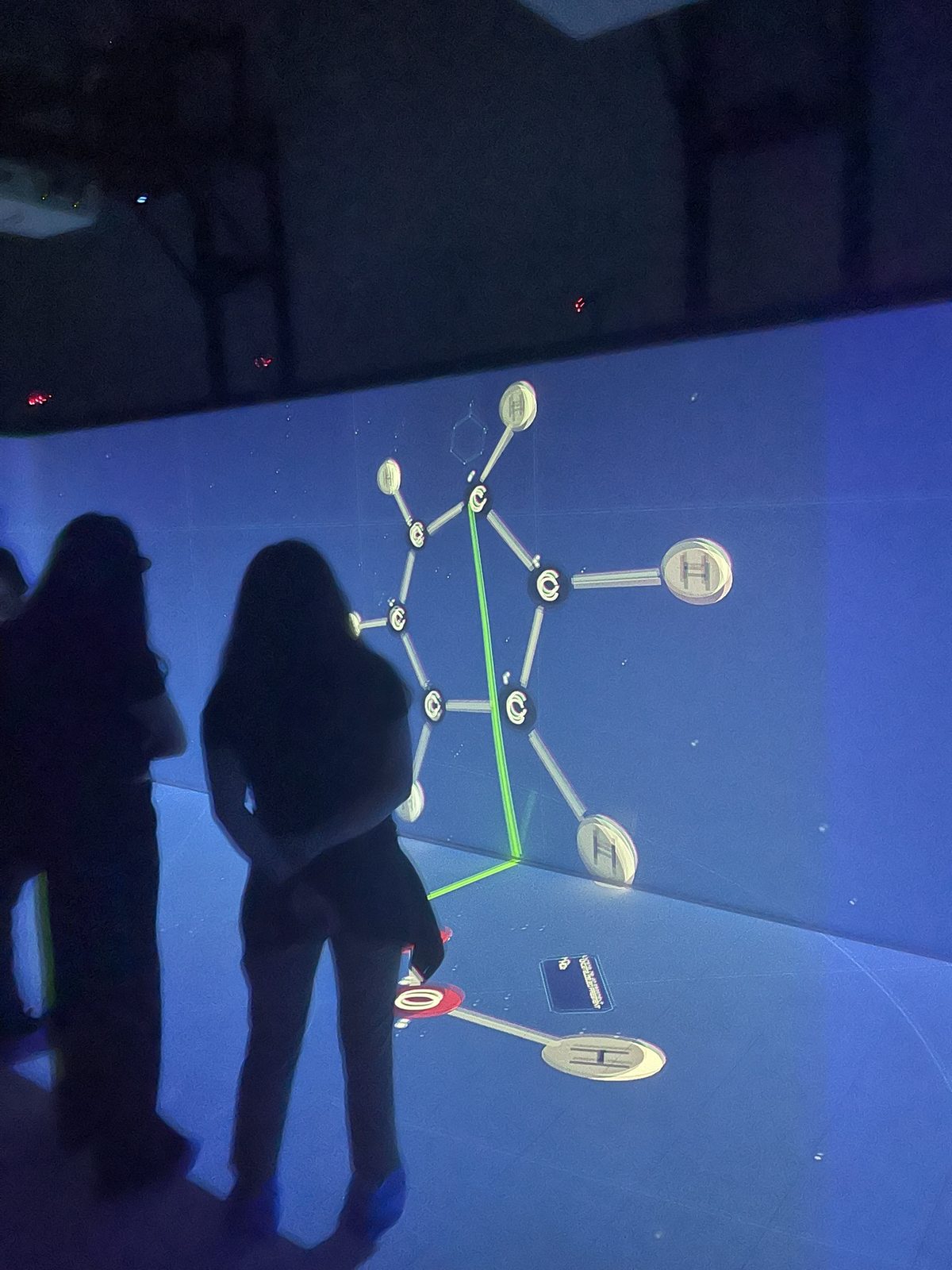
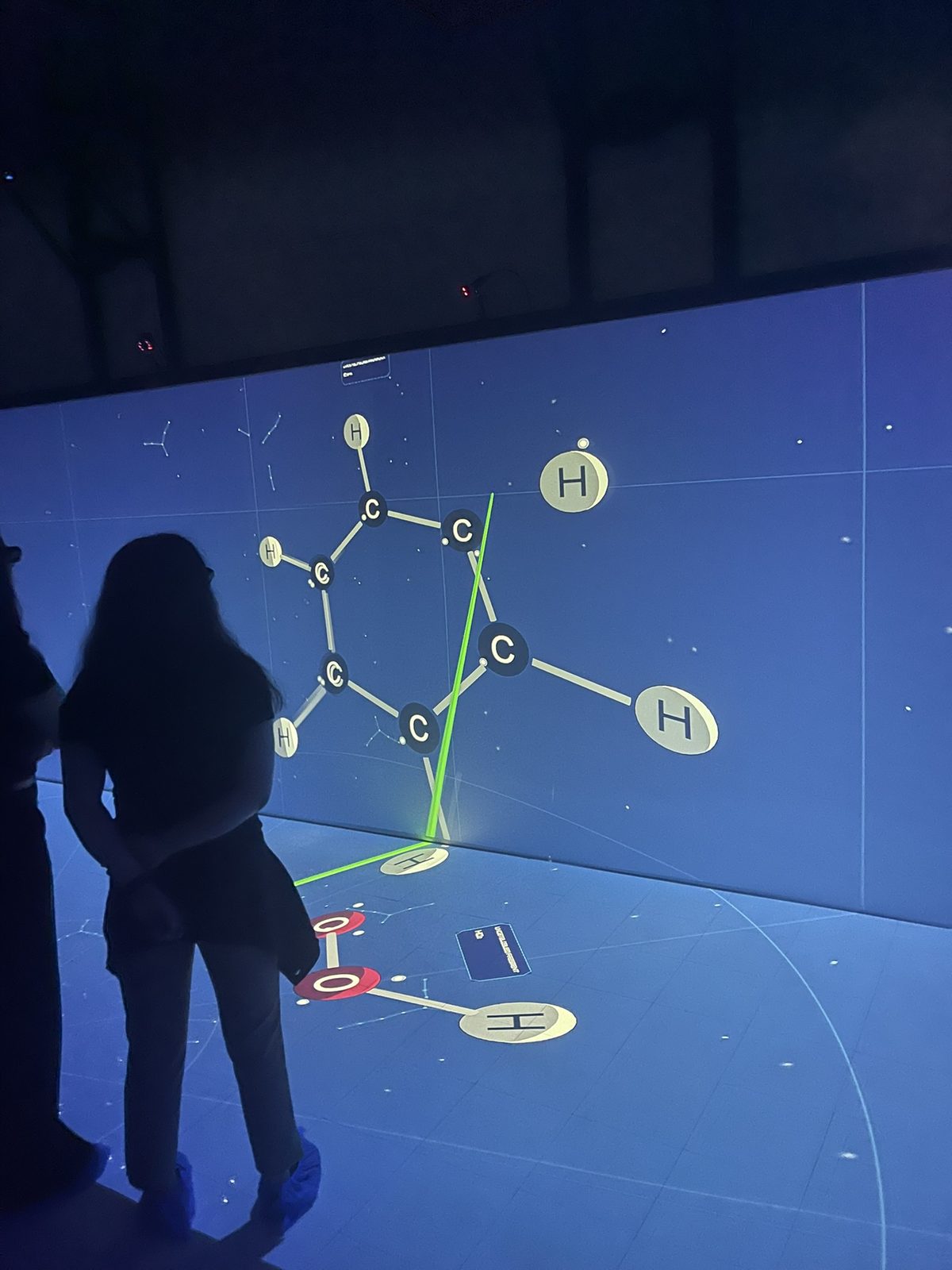
Chemistry. 3D molecules fill the walls and the floor
Gear
Tracked 3D glasses and a handheld controller to point at atoms and move them
Guided
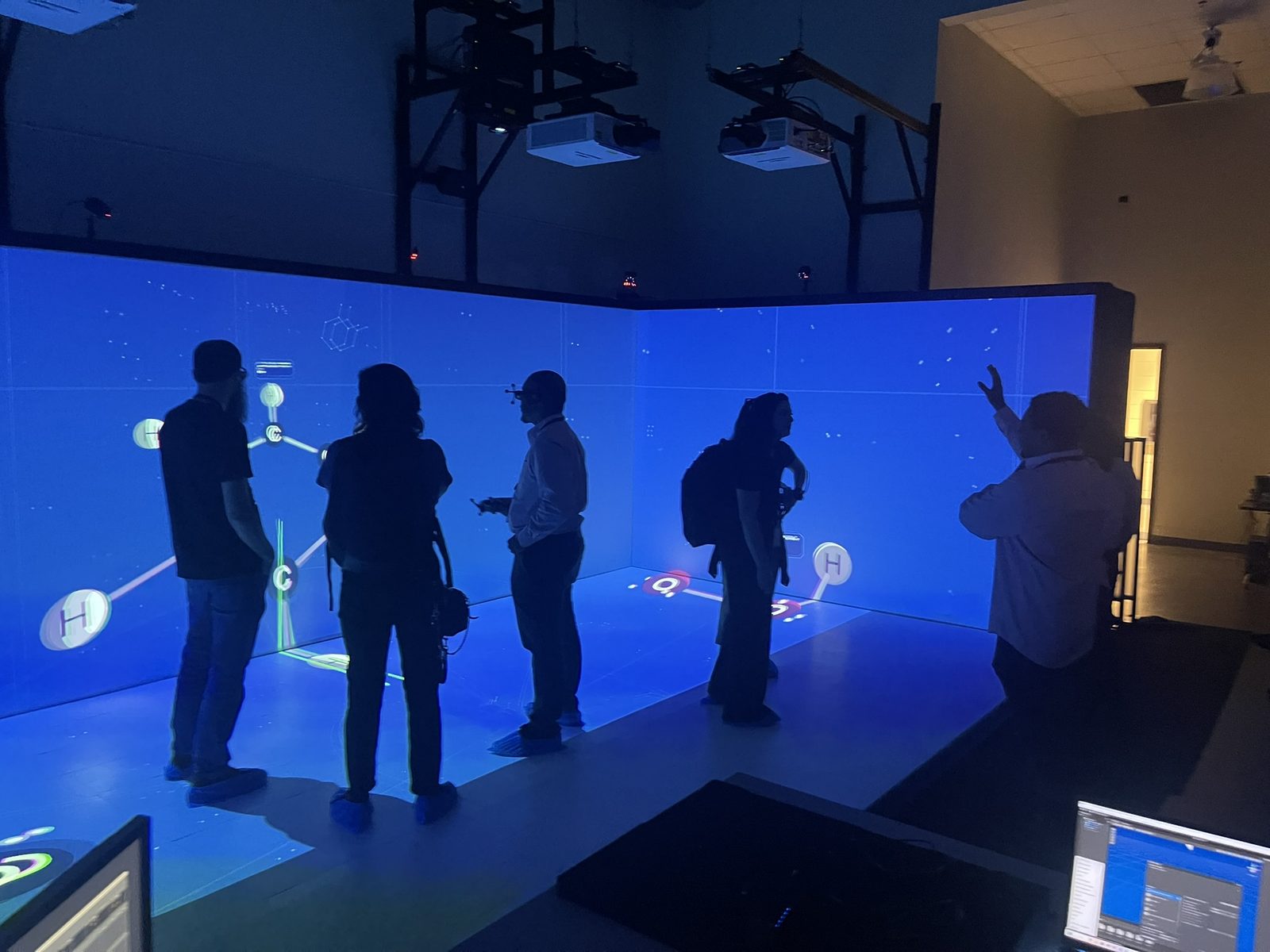
A guide at the control station runs the scene and explains it
Visitor rule
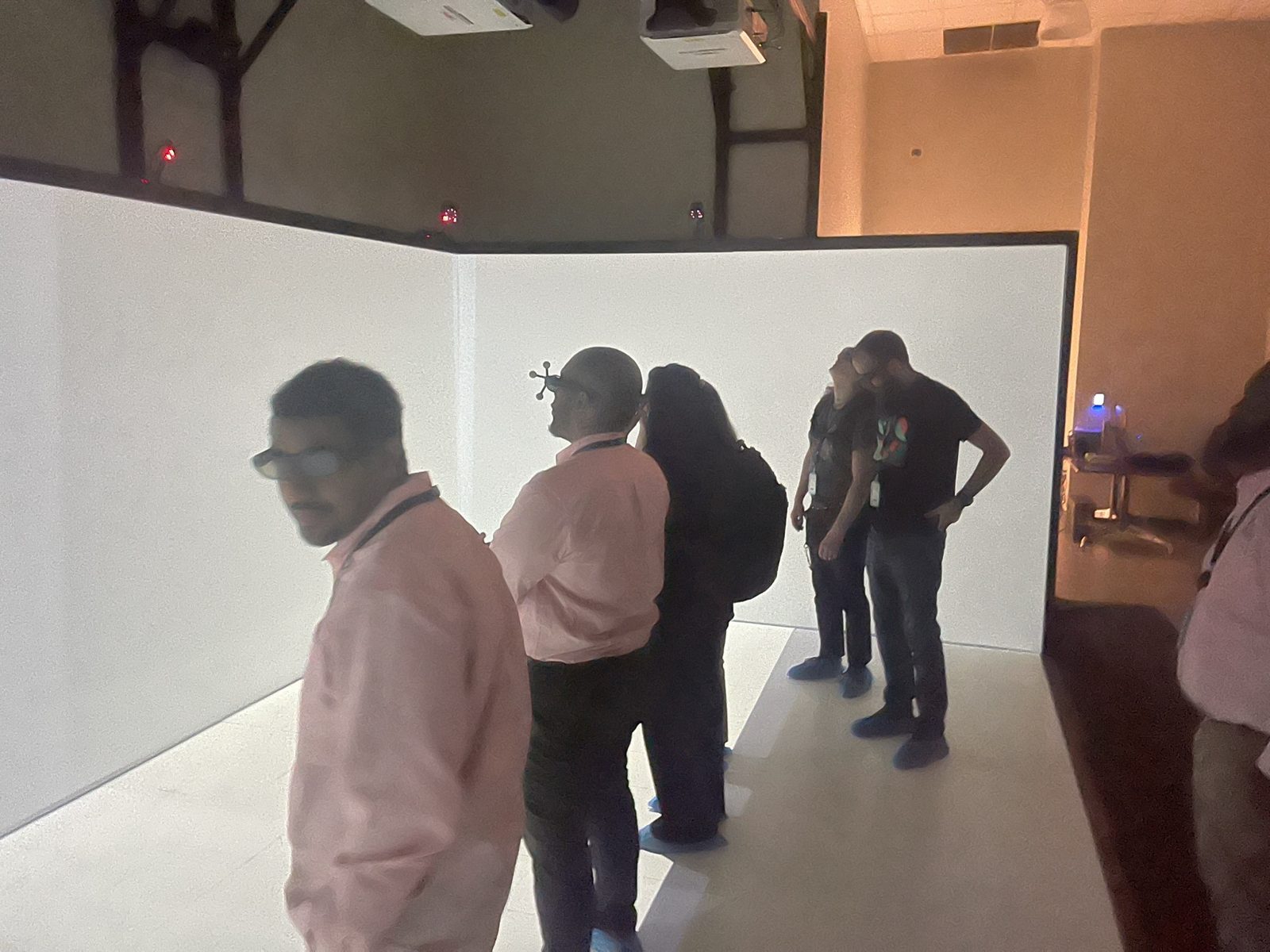
Keep your shoes on and put shoe covers over them before you step onto the projected floor
Mobile CAVE link
K–12 education and mobile STEAM outreach (SP-01)
02
What it is
On the October 2026 visit, Southern University's stationary CAVE ran a chemistry demo. Molecules filled the walls and the floor in 3D. Visitors looked at them from every side, picked out parts and explored how the pieces fit together.
The demo shows what a CAVE does best: it takes science at a scale too small to see and makes it large enough to walk around. A group stands inside the same molecule and talks about it together.
A CAVE is a room where projectors fill the walls and the floor with 3D images. Southern University's room, built by Fakespace Systems Inc., uses four projectors for 3D (stereo) images across the walls and the floor. Visitors wear tracked 3D glasses so the images appear in depth, and a handheld controller lets them point at an atom and move it. The room itself has its own deep dive (Stationary CAVE).
03
How it works
Before stepping onto the projected floor, every visitor keeps their shoes on and puts shoe covers over them. Groups hear the rule before they arrive.
Tracked 3D glasses let each visitor see the images in depth, and the view follows the viewer as they move.
The molecule fills the walls and the floor around the group, so everyone stands inside the same model.
A handheld controller points at atoms and moves them. Visitors select a part, turn it and look at how it connects to the rest.
A guide at the control station explains what the group is seeing and answers questions, so the demo becomes a lesson instead of a show.
04
Impact
Chemistry that every student can see
The demo makes chemistry visible. Bonds, shapes and structures that students usually meet as flat drawings become objects they can walk around and handle. Research on molecular VR shows why that matters: in a 2018 study published in Science Advances, researchers at the University of Bristol found participants were ten times more likely to succeed at difficult molecular tasks, such as tying a small protein into a knot, when they worked with molecules in interactive VR.
Learning that reaches more kinds of learners
Shared 3D rooms help students who struggle with spatial ideas. A 2020 study of collaborative learning in a CAVE found significantly higher learning gains than textbook learning, with large effect sizes, and the largest benefit went to students with low spatial ability. A room-sized molecule gives those students a way into chemistry that a page cannot.
The demo shows how a CAVE turns data too small or too complex to see into an object a group can handle. That supports teaching and research alike: a class can study a structure together, and a researcher can show a model to colleagues and visitors in the same space.
The guided format matters as much as the picture. A guide leads the group, points out what to look at and asks questions, so the scene becomes the starting point for discussion rather than something people only watch.
The demo also shows where the field is heading. Interactive molecular tools now let several people work on the same molecule at once. A CAVE with a library of science models can follow that trend, and the same models can travel on the Mobile CAVE.
05
Why Southern University
The demo connects to the university's science teaching. Southern University trains teachers through its School of Education and runs classroom VR through SURADD (Southern University Reaching Across the Digital Divide). A 3D molecule a visiting class can walk around is the kind of lesson those programs carry into schools.
The demo also gives the university a way to welcome the public onto campus. A room-sized molecule is something a parent, a teacher or a middle schooler understands in minutes, and each visit introduces new people to Southern University's science, engineering and education programs.
The university has the setting to host it. It runs a stationary CAVE on campus, a student team that operates the Mobile CAVE and an XR Development Studio that builds VR content. The demo is where those pieces show the public what they can do.
06
Who it serves
Students and teachers
Visiting classes explore molecules in 3D, linking the demo to chemistry and science lessons.
University researchers and faculty
Faculty use the demo to show their work and to study how people learn in 3D.
Families and visitors
People see chemistry at the size of a room and leave knowing what the CAVE is for.
Partners and funders
Visitors see the CAVE in action in minutes, which explains the program better than any description.
07
Why fund it now
The demo is working and ready to grow. The October 2026 visit showed it running in the stationary CAVE with a guide and a clear visitor routine. Funding now turns one demo into a library: more chemistry and science models and the lesson plans that go with them.
The Mobile CAVE is getting ready to open. Funding the demo now means the truck arrives in schools with tested science scenes for STEM teaching.
Funding also supports how the demo is used, not only what it shows. Paying for trained guides, scripted sessions and follow-up materials makes sure each visit teaches something that lasts.
08
How it connects
The demo runs in the Stationary CAVE. Its scenes are built with the kind of tools used in the XR Development Studio. It links to Classroom VR and teacher training, and the room is the same one used in Computational thinking research. On the Mobile CAVE side, it connects to K–12 education and mobile STEAM outreach (SP-01), aligned with SURADD. The Vision module shows how it fits the larger plan.
09
Questions funders ask
It is a working demo that ran for visitors in October 2026. Funding builds it into a library of guided science scenes and lesson plans.
Visitors view molecules from every side, select parts with the controller and explore how the pieces fit and bond.
A CAVE puts a whole class inside the molecule at once, so students can point, discuss and work through a structure together.
Yes. The Mobile CAVE takes the same kind of 3D room to schools and communities, and its K–12 sub-project matches the demo.
Keep your shoes on and put shoe covers over them before stepping onto the projected floor, then put on the tracked 3D glasses. A guide leads every session.
10
Sources
- New drug and material discoveries to be untangled in VR (University of Bristol, on the Science Advances study)
- Benefits of immersive collaborative learning in CAVE-based virtual reality (de Back et al., 2020)
- Cave automatic virtual environment (Wikipedia)
- SURADD: Connecting Minority Communities Pilot (NTIA BroadbandUSA)
- CAVE demo: chemistry molecules, AM Lab site
- Stationary CAVE, AM Lab site
- Sub-projects, Immersion in Motion