
Southern University’s labs · 01
Metal 3D printing lab
Southern University’s metal additive manufacturing lab builds solid metal parts from metal powder and metal wire, using lasers and other heat sources. It is being set up now, mainly for graduate research.
At a glance
Powder, wire and a laser. A metal part, layer by layer.
Behind this page: lab video of researchers at the Aconity3D metal printer.
More informationWhat it does
Real metal parts, from a digital file.
This lab works with metal powder and metal wire. A laser or other heat source melts the metal, and the machine builds the part one layer at a time.
Replacement parts
Make a part that is hard to buy, if it is designed, tested and approved for its use.
Prototypes
Make a working metal version of a design before full production.
Special tools
Build custom tooling for a plant or shop.
Small batches
Make a few parts without a full production line.
New material mixes
Research parts that combine more than one metal.
The machines
Five machines: shape the metal, then test it.
The lab videos show five machines by name: four that shape metal and one that tests it. Scroll each one below to see it come apart and learn its main parts.
Machine 01
Powder-fed laser printer
InssTek MX-Lab
Metal powder is blown into a laser beam at the print head. The melted metal builds the part one layer at a time.
Background: the full InssTek MX-Lab film, start to finish.
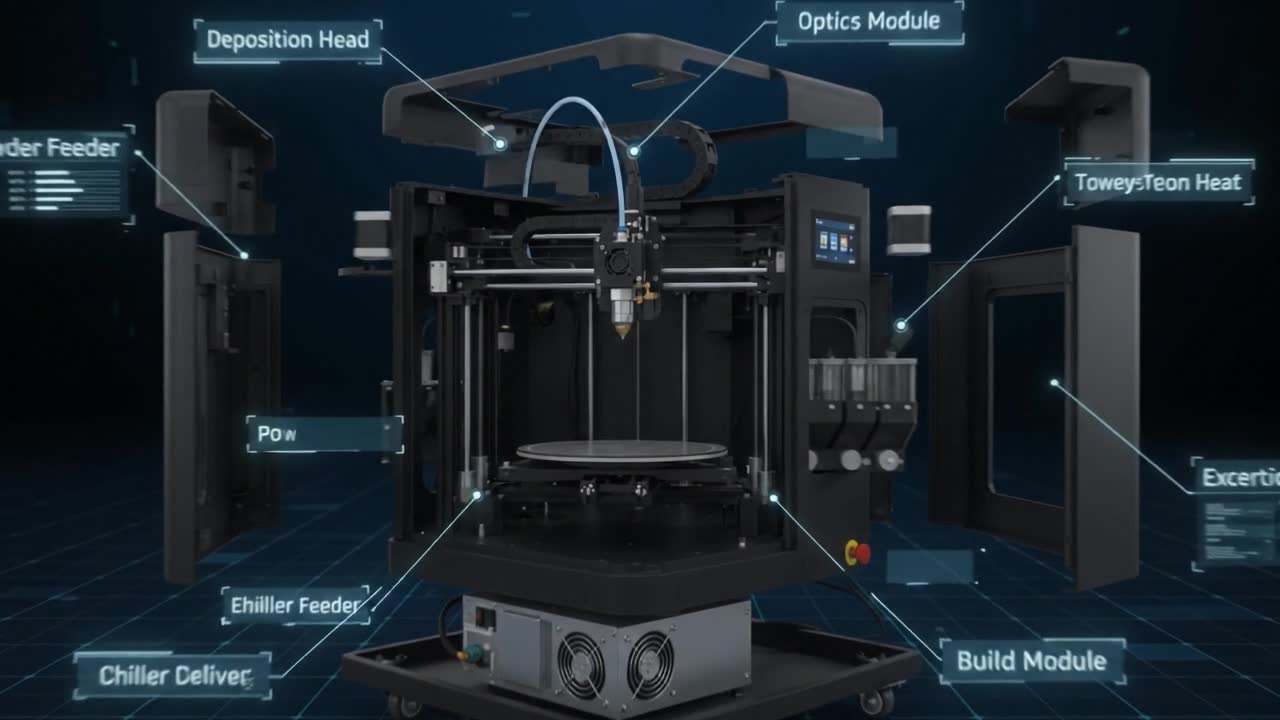
Machine 01 · Powder-fed laser printer
Open the InssTek MX-Lab.
AI-generated animation. Scroll to take it apart.
InssTek MX-Lab · main parts
Powder feeder
Holds the metal powder and sends it to the head.
Deposition head
Where powder meets the laser and becomes metal.
Optics module
Shapes and aims the laser.
Build module
The platform the part grows on.
Chiller
Keeps the laser and machine cool.
Machine 02
Laser powder bed printer
Aconity3D
A thin layer of metal powder is spread across a bed. A laser melts the shape of the part into it, then the next layer is spread on top.
Background: the full Aconity3D film, start to finish.
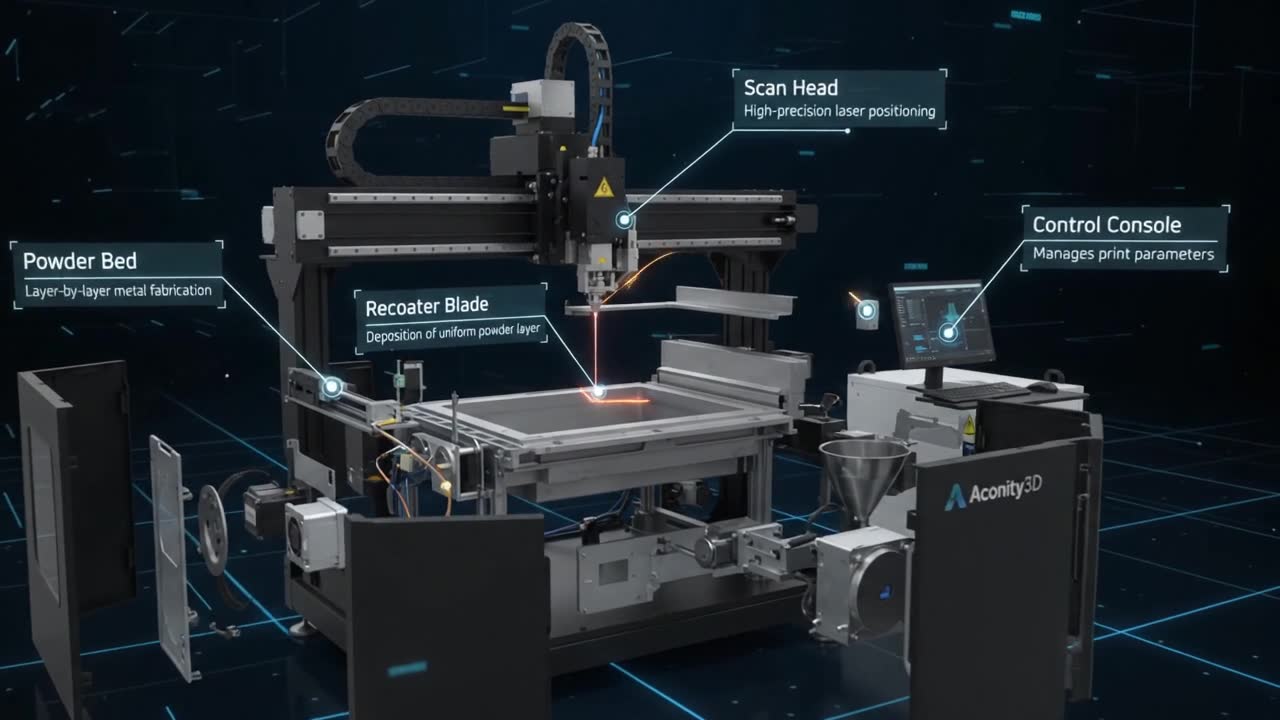
Machine 02 · Laser powder bed printer
Open the Aconity3D.
AI-generated animation. Scroll to take it apart.
Aconity3D · main parts
Scan head
Moves the laser beam fast and precisely.
Powder bed
The tray of powder the part is built in.
Recoater blade
Spreads each fresh layer of powder.
Laser fiber cables
Carry the laser light to the scan head.
Linear drive system
Moves parts of the machine smoothly.
Control console
Where the operator sets up and runs the job.
Machine 03
Wire EDM machine
EDMMax 434W
A thin moving wire cuts through metal with electric sparks, while coolant washes the cut. It cuts very precise shapes, even in hard metal.
Background: the full EDMMax 434W film, start to finish.
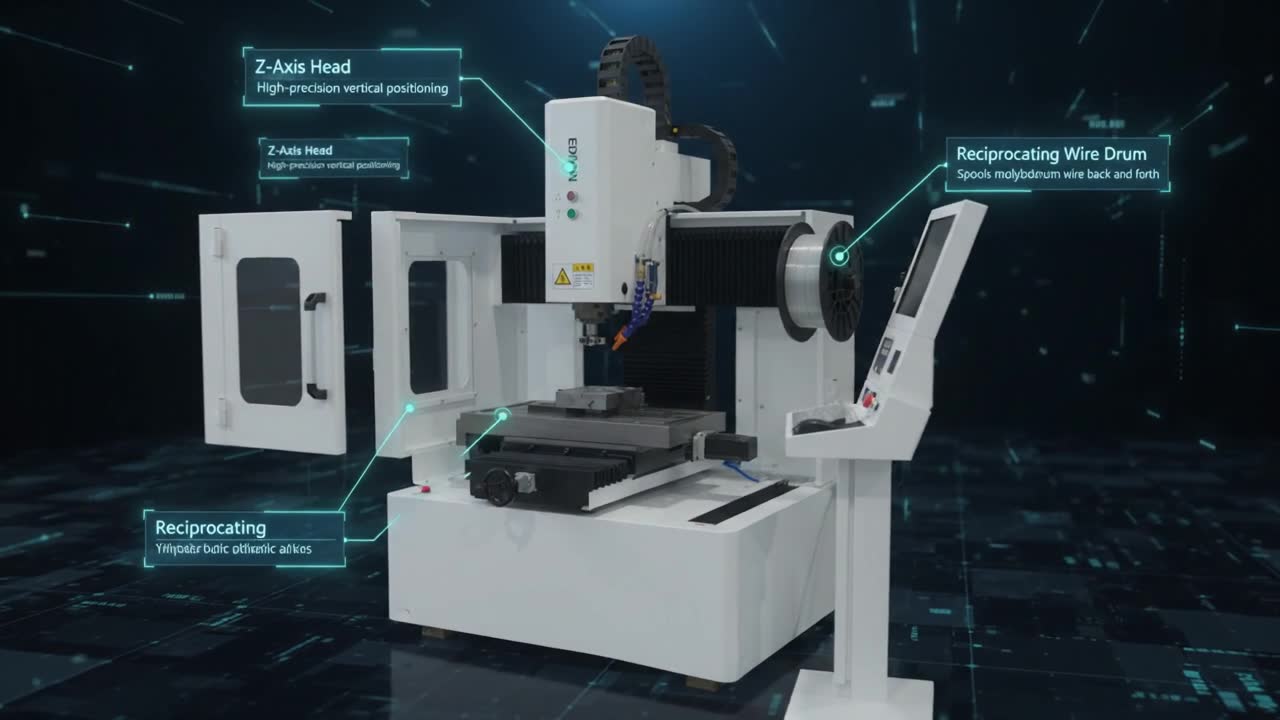
Machine 03 · Wire EDM machine
Open the EDMMax 434W.
AI-generated animation. Scroll to take it apart.
EDMMax 434W · main parts
Wire
A thin moving wire that does the cutting.
Z-axis head
Holds and guides the wire.
Workpiece
The metal block being cut.
CNC control
The screen and buttons that run the cut.
Coolant
Cools the cut and carries away tiny bits of metal.
Machine 04
CNC turning center (lathe)
Mazak Quick Turn 20 (QT-20)
The metal spins in a chuck while a cutting tool shapes it. The Mazatrol control lets the operator set up the cut on screen, step by step.
Background: the full Mazak Quick Turn 20 (QT-20) film, start to finish.
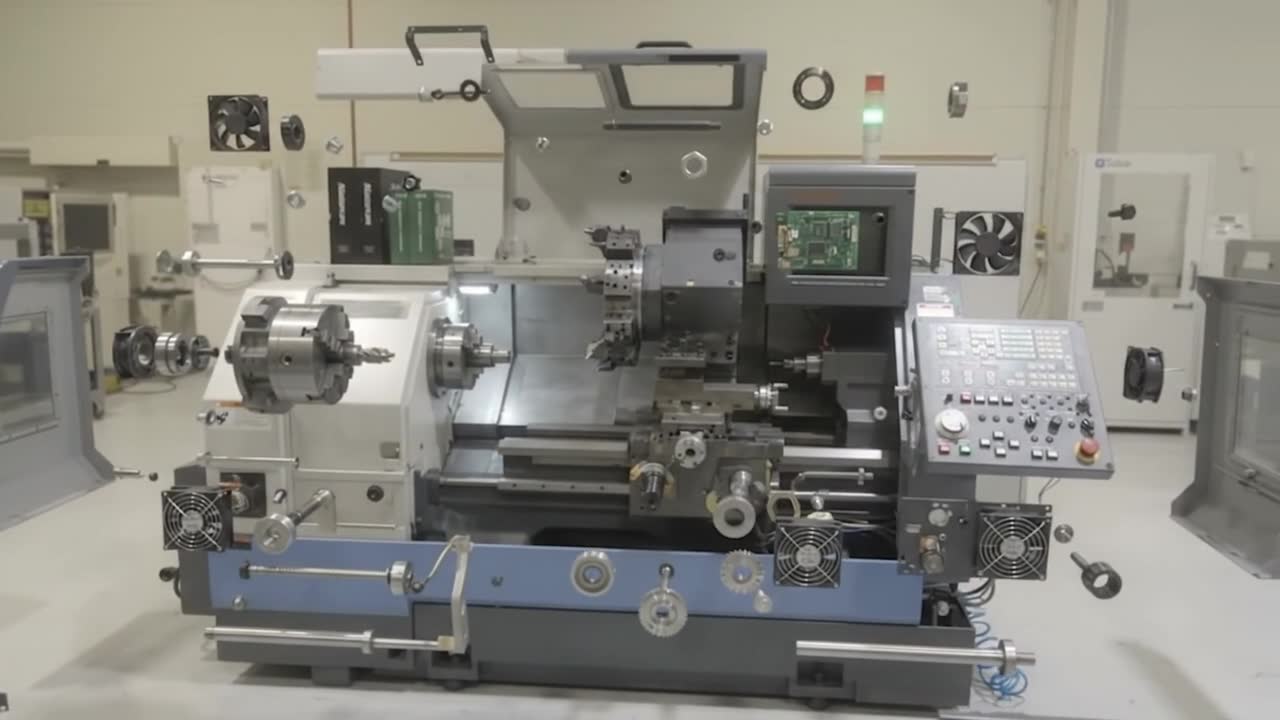
Machine 04 · CNC turning center (lathe)
Open the Mazak Quick Turn 20 (QT-20).
AI-generated animation. Scroll to take it apart.
Mazak Quick Turn 20 (QT-20) · main parts
Hydraulic chuck
Grips the metal and spins it.
Turret
Holds the cutting tools and swaps them in.
Spindle motor
Turns the chuck.
Servo drives
Move the tools precisely.
Control panel
The Mazatrol screen, keypad and hand wheel that run the job.
Cooling fan and coolant
Keep the machine and the cut cool.
Safety door
Closes the cutting area while it runs.
| Item | Detail |
|---|---|
| Maker | Yamazaki Mazak Corporation |
| Type | 2-axis CNC turning center (slant-bed lathe) |
Machine 05
Nanomechanical tester (nanoindenter)
Hysitron TriboIndenter (TI 900 series)
A tiny, precise tip presses into or scratches a material and measures how it responds. It tells researchers how hard and stiff thin films, coatings and small features are.
Background: the full Hysitron TriboIndenter (TI 900 series) film, start to finish.
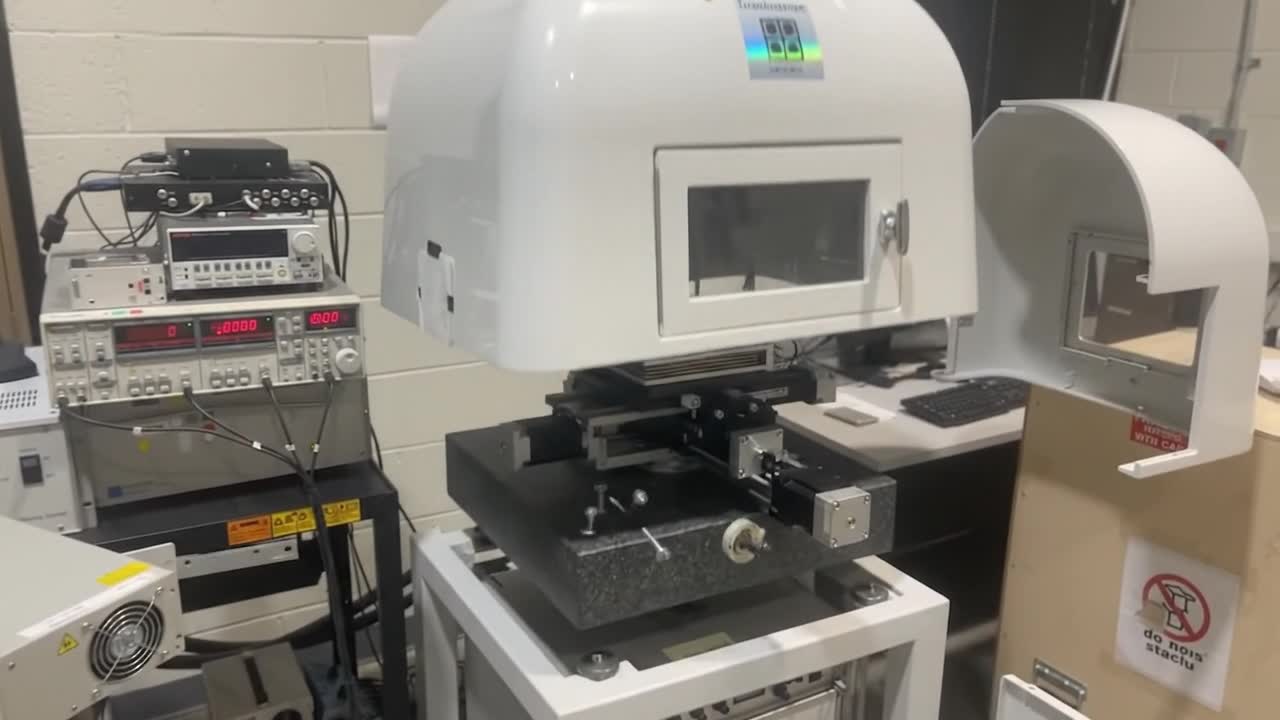
Machine 05 · Nanomechanical tester (nanoindenter)
Open the Hysitron TriboIndenter (TI 900 series).
AI-generated animation. Scroll to take it apart.
Hysitron TriboIndenter (TI 900 series) · main parts
Nanoindentation
Press a tiny tip into the surface and measure the depth.
Nanoscratch
Drag the tip across to test how well a coating holds.
Nanowear
Repeat passes to see how a surface wears.
Hardness and modulus
Work out how hard and how stiff the material is.
| Part | What it does |
|---|---|
| Acoustic and environmental hood | The white curved enclosure with a hinged front door. It blocks heat changes, sound and vibration during tests. |
| Granite base and isolation platform | Inside the stand. Keeps floor movement from shaking the test. |
| Controller rack (bottom shelf) | Control electronics, transducer amplifiers and motor drives. |
| Electronics cart (left) | Stage controllers, transducer conditioning units and power supplies. |
| Heating and cooling stage controller | Bottom unit on the cart, for testing at different temperatures. |
Made by Hysitron, now part of Bruker.
Materials
Metals the lab works with.
| Metal | Common use |
|---|---|
| Aluminum | Light parts and prototypes |
| Inconel 625 | Heat- and rust-resistant parts |
| Inconel 718 | Aerospace and high-performance parts |
Metal vs polymer
How metal printing differs from plastic printing.
| Metal printing | Polymer printing | |
|---|---|---|
| Material | Metal powder or wire | Plastic filament, resin or powder |
| Heat source | Laser, electron beam or electric arc | Heated nozzle, laser or light |
| What it makes | Metal parts | Plastic models, prototypes and parts |
| Industries | Aerospace, manufacturing, tooling, repair | Product design, prototyping, education |
| How hard to run | Needs special safety controls and finishing | Easier for beginners |
| Use at the university now | Mostly graduate research | Teaching already happens |
Five steps
Step 1
Metal powder or wire goes to the print head.
Step 2
A laser or other heat source makes a small pool of melted metal.
Step 3
The metal hardens on the build plate or the layer below.
Step 4
The machine adds layer after layer until the part is done.
Step 5
The part may be machined, heat-treated, inspected or polished, depending on the machine and the metal.
How a metal part gets built.
Who can use it
Graduate research now. More later.
| Group | Today |
|---|---|
| Graduate researchers | The main users |
| Undergraduates | No full class yet |
| K–12 | No metal printing class or outreach |
The AM Lab training covers 3D printing basics with VR practice and a real printer. The metal lab shows learners where those skills can lead.
Deep dive
Go deeper.
The full story of this lab: what it is, why it matters, why Southern University is pursuing it and why it deserves funding.
More labs
See the other labs.
Request this service
Request this service.
Ask about metal 3D printing for a project, a class or a research partnership.
- Metal 3D printing
- Research
- Training